Trinity U Discovery Table Lets Student Prospects Engage with Touch
- By Dian Schaffhauser
- 05/13/14
Prospective students at Trinity University in San Antonio have gained a unique way to spark potential fields of study and publicize campus activities as they wait for campus tours to begin. When they arrive at the Admissions Office Welcome Center, they can interact with a 55-inch table display that helps them explore their academic interests and learn about other campus offerings. On either side of the "Discovery Table" are cards with 25 different quotes representing a personality type. When the student chooses cards with sentiments that resonate and places them on the table, an application displays potential areas of study, on-campus resources and related multimedia, such as images and videos.
Each quote relates to a persona or student interest. For example, the "scientist" card quotes Albert Einstein: "You can't blame gravity for falling in love." A "designer" card quotes Steve Jobs: "Design is not just what it looks like and feels like. Design is how it works." When that card is set on the screen, academic fields such as art and art history, engineering and science show up with links to other campus information.
| |
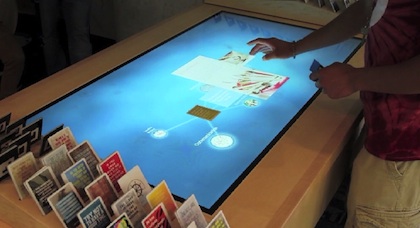
When prospective students place cards on Trinity University's MultiTaction table an application displays potential areas of study, on-campus resources and related multimedia, such as images and videos. |
|
The table was put in place as part of an aggressive marketing effort by the university to increase the number of applications coming in from new students. Rob Chapman, director of the AT&T Center for Learning and Technology and the project's team leader, explained that it was "part of an overall vision to provide a unique discovery experience for prospective students."
The system was designed by Push Offices, a Venice Beach creative firm. The table display is a MultiTouch MultiTaction installation that recognizes 2D barcodes on the cards and allows the viewer to interact with the display through touch.
"The MultiTaction Enriched Reality enabled us to create software to seamlessly integrate with the display to inspire visitors and create awareness about all Trinity University has to offer to students," said Eric Boisvert, managing partner from Push.
Added MultiTouch General Manager Timo Korpela, "The advanced technology is completely hidden from the end users who intuitively use the personality cards to interact with the display application. This installation turns one of the most important decisions in a student's life into an engaging and immersive experience."
About the Author
Dian Schaffhauser is a former senior contributing editor for 1105 Media's education publications THE Journal, Campus Technology and Spaces4Learning.