Accessibility-as-a-Service in Georgia
Georgia Tech's AMAC Accessibility Solutions and Research Center is a full-service resource that supplies repositories of accessible digital textbook files, Braille, assistive software and remote captioning for students with disabilities, as well as training and consulting services.
|
Category: Student Systems and Services
Institution: Georgia Institute of Technology
Project: AMAC Accessibility Solutions and Research Center
Project lead: Christopher Lee, head, AMAC Accessibility Solutions and Research Center
Tech vendors/partners:
|
As faculty members add online and multimedia elements to their courses, colleges and universities across the country continue to struggle to ensure that disabled students (and employees) have equal access to course material and university Web sites.
But by taking a centralized approach, the State of Georgia finds itself in an enviable position. Its AMAC Accessibility Solutions and Research Center, situated in the Georgia Institute of Technology's College of Architecture, has grown into a hub for training, technical assistance and manufacture of hard-copy textbooks and publisher files into accessible media, for universities in Georgia and across the country.
Learn about AMAC’s comprehensive accessibility services. (video courtesy of Georgia Tech) |
Besides ensuring student access to content, the approach also helps universities avoid duplication of effort. "We started by asking questions such as: How many universities across the state were converting the same book, and did they have the staff to do it?" explained Christopher Lee, director of AMAC.
Launched in 2007, AMAC has grown into a full-service center that supplies repositories of accessible digital textbook files, Braille and remote captioning for students with disabilities, as well as consulting services. With 50 employees, AMAC serves 22 technical colleges and 59 universities in Georgia, and does post-production work for approximately 275 universities nationwide. In 2013, AMAC estimated it saved member institutions a combined $2,474,522 compared to the costs of generating accessible material themselves.
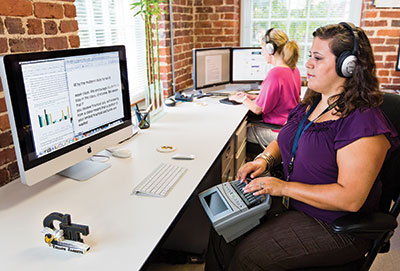
Remote-captioning a class at AMAC (photo courtesy of Georgia Tech) |
The center has developed agreements with 92 percent of educational publishers to clear the copyrights for accessible texts. More than 2,000 post-secondary institutions use its Access Text Network (ATN), which was launched in 2009 with funding from the Association of American Publishers to allow universities to make requests to textbook publishers for electronic files and permissions. (ATN uses a high-end federated search of participating publishers' databases and digital repositories through ONIX data feeds to match requests to available publisher files.)
In addition to textbook content, AMAC provides accessible software thanks to its agreements with 20 assistive technology manufacturers. Students can access AMAC's portal to download tools such as Scan/Read Pro, Worksheet Wizard, Write Now, PDF Builder, Text Cloner Pro, ReadHear and Universal Reader.
Developing a centralized accessibility service center was by no means easy. "By my understanding we are the only center like this in the country," said Lee. "We had to be social entrepreneurs, because although the initial money we got from the state in 2007 was great, we had to show there was an actual need out there. We became a small business. We had a business model and short- and long-term goals." Although the center was created to serve Georgia's universities, use of its services was not mandatory. "But we had 28 of 35 institutions come on board right away," he added, "which meant that we had to ramp up very quickly."
AMAC used Intuit QuickBase to develop applications that track memberships and requests for services, as well as generate reports. "We chose QuickBase because we needed to ramp up quickly and it was flexible and somewhat easy to set up," Lee said. "It was actually intuitive for users and the report writing was phenomenal." The center provides training webinars via Adobe Connect, and uses MailChimp for its list serves.
Once it was established, AMAC expanded its offerings to private and technical colleges in Georgia and two years later it started offering services to institutions in other states. "We already had publishers' permission to work with our Georgia institutions, and we have this great repository, so we thought why not help out other institutions," Lee explained. "We can receive 500 orders a week, averaging between 600 and 800 pages each," he said. "We touch every single page from a navigation and pagination standpoint."
AMAC has continued to innovate in response to customer needs. A Student Download Center provides students access to a secure, individualized textbook and assistive technology portal. AMAC also has developed an application called the Student Accommodation Manager (SAM), a web-based tracking and reporting tool for use by university disability service offices, helping them manage student data, case notes and accommodation letters. "It was developed from our ordering system," Lee explained. "We had campuses say they love our ordering system and ask if we could develop something that would help them manage their offices. One goal is to use SAM as a research tool to track accommodations, retention and graduation rates of students with disabilities."
AMAC launched remote captioning services in 2011 and an assistive technology lending library in 2012. In 2013 it started providing consulting services to help organizations improve Web sites and content accessibility. "We have a contract with the Georgia state ADA coordinator's office to do work with state agencies, because many of them don't have accessible Web sites and don't understand how you do can do some simple things to create structured documents," said Joy Kniskern, principal investigator of assistive technology initiatives at AMAC.
This fall, AMAC will offer a six-week MOOC on Universal Design of Information and Communication Technologies through Georgia Tech and Coursera. Developing the MOOC will help AMAC consolidate its knowledgebase of best practices into robust, archived Web resources to help other programs, states and territories understand information accessibility and the AMAC business model. "We are trying to help people understand that accessibility and universal design is something you have to bake into your organization from A through Z," Kniskern said. "It can't be something that is just layered on."
According to Lee, AMAC has been growing at a rate of 15 percent per year and it has the capacity to continue that growth. But his preference is for AMAC to become something of a blueprint for other states to follow. "I would love to see them take this centralized model and duplicate it."
|
For more information on the Campus Technology Innovators program, visit the awards site.
|