Report: Big Jumps in ResNet Funding, Bandwidth and Outsourcing
Today's colleges and universities face an ever-increasing demand for bandwidth in residential networks. And as schools upgrade tech infrastructure, increase ResNet funding, bolster bandwidth and/or consider outsourcing, they are increasingly "on the lookout for ways to improve the value and performance of their ResNet to meet student demand," according to the 2015 State of ResNet Report.
Published by The Association for College and University Technology Advancement (ACUTA), the National Association of College and University Business Officers (NACUBO) and the Association of College and University Housing Officers- International (ACUHO-I), the State of ResNet study evaluates residential network practices and policies in higher education. This year (the fourth out of a five-year study), a total of 550 respondents from higher ed institutions across the U.S. completed the survey — the largest number since the study's inception.
Key findings from the report include:
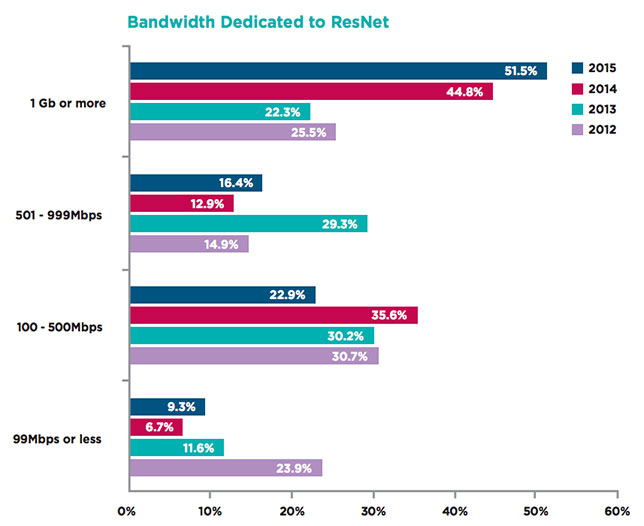
Bandwidth Is Reaching New Heights. For the first time, more than half of the schools surveyed (51.5 percent) dedicate at least 1 Gb to the ResNet. This is double the number from 2012, when only 25.5 percent of schools did so.
Source: 2015 ACUTA/NACUBO/ACUHO-I State of ResNet Report
Costs Are Increasing. Seventy percent of institutions surveyed expect the cost of the ResNet to increase over the next two years. Three out of five universities are balancing bandwidth costs through shaping or by combining their ResNet services with other campus IT services. Nearly half of institutions have increased or are considering an increase in student/user fees.
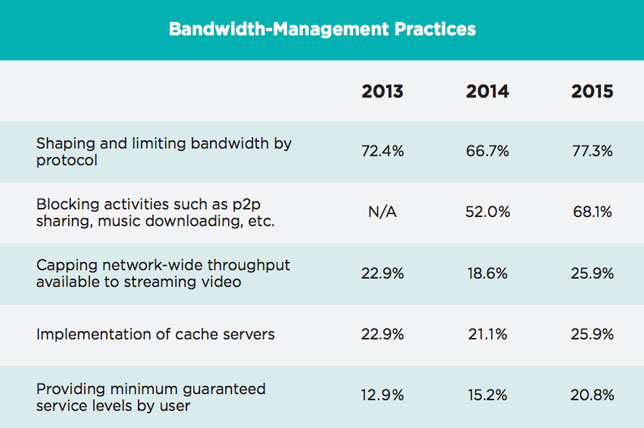
More Bandwidth-Management Practices. While ResNet funding has increased, the use of more bandwidth-dependent devices continues to challenge universities. As a result, all bandwidth-management practices are on the rise. The most popular methods: limiting by protocol and blocking activities such as P2P sharing and music downloading. In addition, one in five schools offer students the option of purchasing additional bandwidth.
Source: 2015 ACUTA/NACUBO/ACUHO-I State of ResNet Report
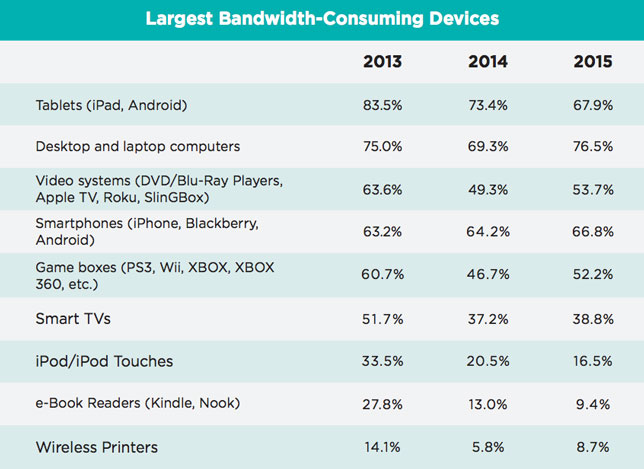
Desktops and Laptops Are the Top Bandwidth Consumers. Desktops and laptops have surpassed tablets as the largest consumers of bandwidth. Still, the ResNet serves a wide array of applications and devices: Seven out of 10 colleges and universities surveyed allow an unlimited number of devices to be connected to the residential network.
Source: 2015 ACUTA/NACUBO/ACUHO-I State of ResNet Report
Campus Wireless Coverage Has Improved, But Not Necessarily in Residential Areas. More than 65 percent of schools now provide wireless connectivity throughout more than 80 percent of their campus, a 20 percent increase since 2013. However, academic and administrative areas continue to receive the strongest coverage compared to common areas, dining halls and residential rooms.
Round-the-Clock Support Is Rare. Less than 15 percent of schools provide 24/7 support for the ResNet. However, among those schools that have outsourced their ResNet, 68 percent have 24/7 support.
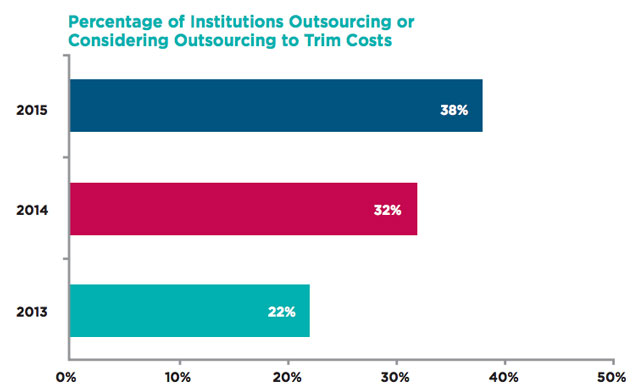
Outsourcing Has Nearly Doubled. The number of schools outsourcing or considering outsourcing some or all ResNet services continues to grow, and has increased from 22 percent in 2013 to 38 percent in 2015.
Source: 2015 ACUTA/NACUBO/ACUHO-I State of ResNet Report
Planning and Funding on the Rise. Over the last three years, there has been a 26 percent increase in schools that have ResNet strategic plans, growing from 34 percent to 60 percent. In addition, more institutions have seen an increase in ResNet funding, jumping from 38 percent in 2014 to 54 percent in 2015.
Security Lags Behind. While security remains a top priority for Business Officers, there is no Information Security or Internal Audits (ISO) team in place at three out of four schools responding to the survey.
"Schools have seen the competitive advantage that comes from the expansion and growth of ResNet bandwidth and WiFi access on their campuses, but with this growth comes an even wider set of challenges," said Dee Childs, chair of the ACUTA Environmental Scanning Committee and Chief Information Officer at the University of Alabama in Huntsville, in a press release. "Schools must continue to examine new ways to enhance network performance and limit risk while stretching value."
The full report is available for free at the ACUTA site.
About the Author
Rhea Kelly is editor in chief for Campus Technology, THE Journal, and Spaces4Learning. She can be reached at [email protected].