Western U To Create Virtual Reality Learning Center
- By Dian Schaffhauser
- 08/27/15
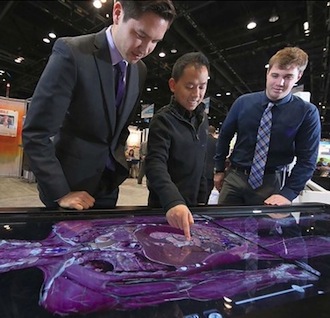 A health sciences university will be opening a new virtual reality learning center in its main library jammed with new technologies.
Students at Western University of Health Sciences will soon be able to take courses
that include virtual dissection and organ exploration.
A health sciences university will be opening a new virtual reality learning center in its main library jammed with new technologies.
Students at Western University of Health Sciences will soon be able to take courses
that include virtual dissection and organ exploration.
The institution, which has campuses in California and Oregon, received an anonymous $100,000 donation, which let the school buy an
Anatomage Virtual Dissection Table. The product
resembles an operating table or hospital bed and displays life-size human forms recreated with data and images taken from patient scans and
cadavers. The company positions the table as an alternative to the traditional cadaver lab.
"This allows you to look inside the body. You see volume. You see tissues. You see in 360-degree access. You can zoom in and out, you can
slice it and isolate tissue types and organs and view the radiographic images," said Robert Hasel, associate dean of simulation, immersion
& digital learning, in a prepared statement. "It's multi-functional in its use. You can embed curriculum in it, everything from information
to testing."
Along with that, the new center will also feature two zSpace 4D displays, the
Oculus Rift and anatomical models on the iPad. The zSpace displays create
stereo holograms of human anatomy that can be manipulated by students wearing special glasses. The Oculus Rift is a head-mounted display that
provides the wearer with a 360-degree immersive virtual reality experience. A project underway with Stanford University School of Medicine Division of Clinical Anatomy will eventually allow students to "tour" human bodies.
The iPad app will provide interactive views of anatomical models.
"This is a great, fun project," said Hasel. "It is going to benefit students and faculty in many ways. We're bringing three-dimensional
teaching into a three-dimensional science, with the combined ability to interact with it." That approach, he noted, would help foster
memorization and provide "an understanding of anatomy in ways that was previously only possible doing cadaver dissections."
The new center will take up about 1,200 square feet on the first floor of the university's Pumerantz Library, which is currently undergoing
remodeling. Once the center is open, students in all of its colleges will be able to access the new technology, and staff will be on hand to
help them use it.
About the Author
Dian Schaffhauser is a former senior contributing editor for 1105 Media's education publications THE Journal, Campus Technology and Spaces4Learning.