Building Learning Spaces in Unexpected Places
Austin Community College transformed an aging shopping mall into a revitalized campus hub and high-tech learning lab.
Category: IT Infrastructure and Systems
Institution: Austin Community College (TX)
Project: Highland Campus ACCelerator
Project lead: Richard Rhodes, president
Tech vendors/partners: Comtarsia, Dell, McGraw-Hill Education, Smart Technologies, VMware
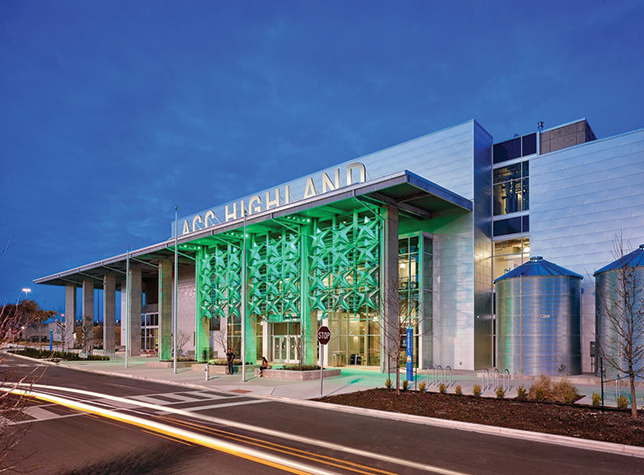
A longtime centerpiece of Austin, Highland Mall has been revitalized as ACC's Highland Campus. (photo by Casey Dunn)
It takes a lot of imagination to envision an aging, moribund shopping mall as a high-tech campus and community hub. But Austin Community College (ACC) executives have worked hard to repurpose the former Highland Mall as the institution's new Highland Campus, which is home to the ACCelerator, a high-tech learning lab providing access to more than 600 computer workstations for individualized learning and small group sessions.
Opened in August 2014, the ACCelerator is spread over 32,000 square feet in a former J.C. Penney store space, with clusters of desktop computer stations surrounded by classrooms and study rooms. Four mobile interactive whiteboards from Smart Technologies support instruction and collaboration. The facility is also home to an extensive support network for students — faculty members, counselors, tutors, librarians and other staff members.
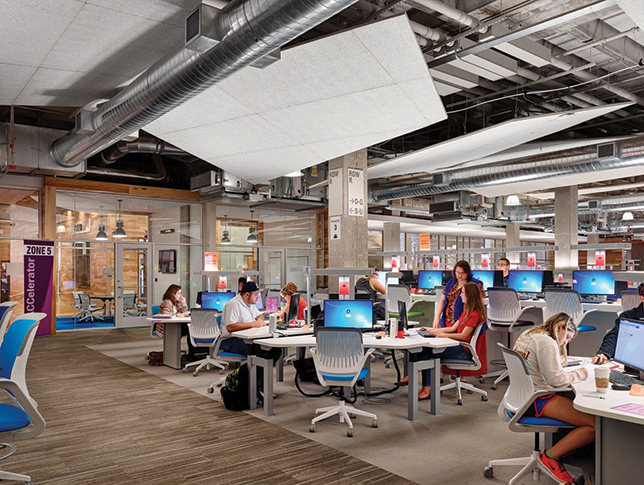
The ACCelerator features clusters of desktop computer stations surrounded by classrooms and study rooms. (photo by Casey Dunn)
Highland Mall was a longtime centerpiece of Austin. "We didn't want to lose that aspect — that it was part of the community and open to everybody," said Stacey Guney, the ACCelerator's director. "First-generation college students going to a traditional campus might feel intimidated or out of place. Nobody has that feeling about going to the mall, even if you don't have money to spend." She said the space lends itself to a pedagogical model in which educators forge deeper connections with the students.
"At the beginning of the semester I love to see the look on students' faces when they walk into this space for the first time," Guney said. "They look around and immediately they think this is not like other experiences they have had."
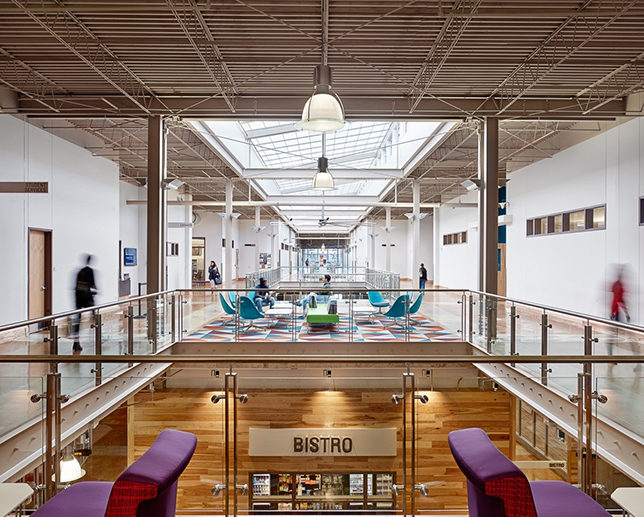
The mall structure provides a familiar, unintimidating environment that lends itself to deeper connections between educators and students. (photo by Casey Dunn)
Richard Rhodes, ACC's president, said the college was determined to use the space to address the high dropout rate in developmental math. "We decided we couldn't continue to deliver developmental math the same way we have always done it," he said. "We had to try something innovative that would keep students on track." Faculty members pulled together the best ideas they could find from other institutions' experiments and brought them into the ACCelerator.

Project lead Richard Rhodes
ACC pulled together all the equivalent subject matter of three semesters of developmental math coursework and employed McGraw-Hill Education's ALEKS adaptive learning software to customize learning materials for each student. Students can complete more than one level of math in a semester, or work on the requirements at a slower pace. With the adaptive learning software, there is total transparency to both student and instructor about how many hours the student is working, how many modules he has attempted, and what he is repeating, Guney said. (Students can pick up the next semester where they left off rather than having to start over again at the beginning of the curriculum.)
The instructors can refer students to the ACCelerator's academic coaches, who help students with time management and organizational skills. According to Guney, in the most recent semester, 95 percent of students succeeding in the program chose to continue. More surprising, of the students who withdrew or didn't pass, 89 percent decided to continue. "Just retaining them is a big deal," she said, adding that the withdrawal rate for African-American and Hispanic students was half of what it typically is for developmental math courses.
While the developmental math program is a cornerstone, the ACCelerator has grown into a digital commons supporting many more uses. Increasingly, faculty members are scheduling their classes and meetings with students there.
The faculty members find they enjoy teaching in the space, Rhodes said. "We had 23 faculty members teaching in the ACCelerator in the first semester and there was some hesitancy on their part. They weren't sure this was going to work," he added. "But after that semester, every single one of them asked to come back the next semester — and as word spread, many other faculty and programs have asked to hold classes there."
The ACCelerator is ringed by group study rooms, which are very popular, Guney said. "We have faculty members who hold office hours here. Students in speech classes flip out of classrooms and into the ACCelerator when they want to do research. Adult basic education courses meet here."
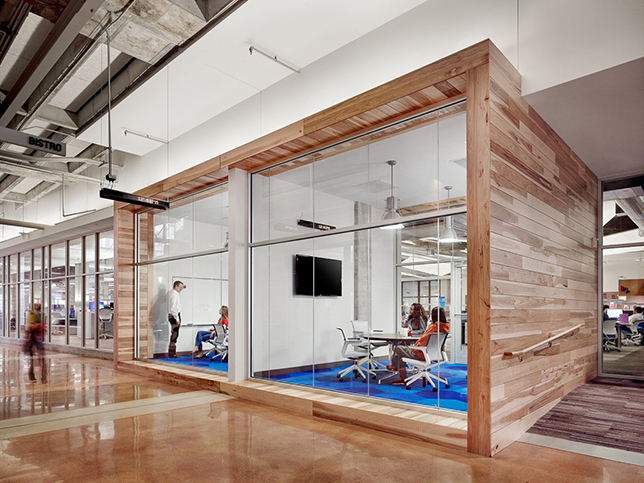
Small group study rooms provide a space for student collaboration, research and even faculty office hours. (photo by Casey Dunn)
For the students, it has become a hub for a variety of activities, Guney said. "There are not even any classes being held in the building today," she said during a May phone interview, "and it is full because this has become where students come to study." She said the students like the virtualized desktops because they can avoid distractions from notifications and social media. (The ACCelerator has 600 Wyse thin clients, with Dell monitors and VMware VUE desktop virtualization software; Comtarsia authentication software is used to validate students.)
The space's flexibility has opened up an array of opportunities, Guney said. In a traditional college environment, space can be siloed and limited to one particular group or department's use. "This is highly flexible," she said. "People come in for maker meet-ups. Our librarians hold sessions on how to access the library's databases."
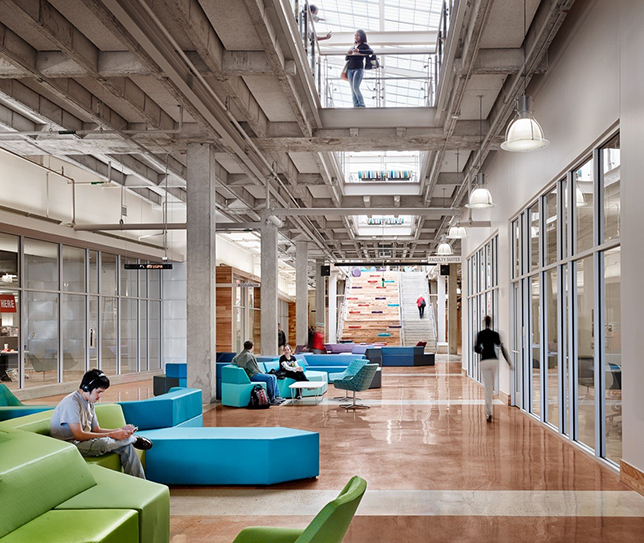
The ACCelerator features a variety of gathering spaces for study groups, maker meet-ups and more. (photo by Casey Dunn)
"This semester we served 5,000 unique visitors, and our headcount for this campus is approximately 3,400, so that means we are pulling people from other campuses," Guney said. "From the beginning it has been clear to me that it is my job to get people to come, get them to stay, and get them to come back, regardless of what it is for."
Rhodes said the ACCelerator fills a need seen on most campuses. "If you were to go to some of our other campuses, and this is true of campuses across the country, you have office space and classroom spaces, but you don't have a lot of gathering spaces," he said. "The ACCelerator has a lot of gathering spaces for students, and they are taking advantage of it. For instance, we don't even offer nursing courses at this campus, and yet the nursing students are gathering at the ACCelerator to study together. It is convenient and it is conducive to small-group study."
In fact, the ACCelerator wears so many different hats, Guney recalled, that during a recent job interview an applicant asked what a typical day is like. She and her co-worker looked at each other and smiled and both said, "We don't know. We haven't had one yet."
Return to Campus Technology Innovators Awards Home