How a Bike Race Led to Experiential, Personalized Learning
When the 2015 Union Cycliste Internationale Road World Championships came to the Virginia Commonwealth University campus, the university embarked on a networked, multimedia, trans-disciplinary exploration of the event — creating a unique learning experience for students.
Category: Teaching and Learning
Institution: Virginia Commonwealth University
Project: The Great VCU Bike Race Book
Project lead: Gardner Campbell, special assistant to the provost and associate professor of English
Tech lineup: Adobe, Apple, Bepress, Canon, Feedly, FeedWordPress, Nikon, Reclaim Hosting, Sennheiser, Slack, Sony, WordPress, WP Engine

The Great VCU Bike Race Book project gave students an opportunity to learn by doing and a chance to become "authors," producing content curated into a virtual "book."
This past academic year, Virginia Commonwealth University was faced with a huge logistical challenge — a world-class international bike race routed through town would disrupt local traffic patterns and supply lines and potentially throw the campus into chaos for a week. But VCU made an innovative strategic choice: The university seized the opportunity to offer students a unique learning experience, using the race environment as a giant learning lab.
As the 2015 UCI Road World Championships race sped through town, VCU could have told students to hunker down in their apartments for a few days of independent reading. But leadership on campus recognized the event's potential for offering students a week of focused learning in a real world environment. Faculty responded enthusiastically with an array of 25 web-connected, truly experiential courses. Students chose from a wide range of topics, from gender studies to physics, all of which tapped the race environment for learning. The resulting project was a networked, multimedia, trans-disciplinary exploration of the UCI event.
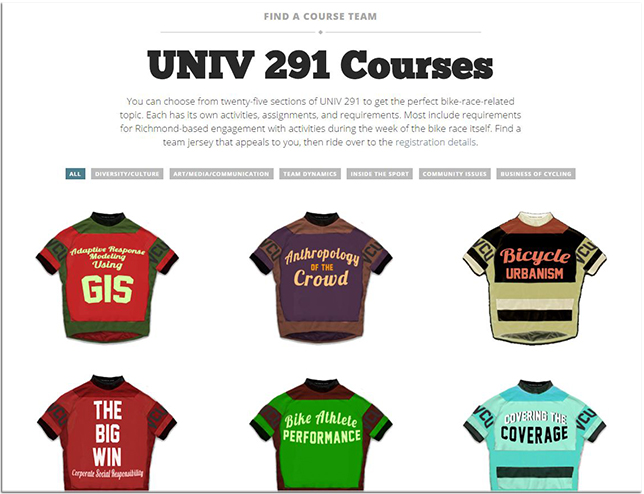
VCU faculty created an array of 25 web-connected, experiential courses devoted to the cycling event.
VCU Associate Professor of English and Special Assistant to the Provost Gardner Campbell, project lead, explained why the bike race was a good venue for learning: "The project was not just the experience of a sporting event. It represented something more, having to do with the possibilities of human accomplishment and the commitment it takes to get to your goals. Our students saw around them, as they were pushing themselves in the context of their own intensive courses, world-class athletes who were committing their hearts and minds and bodies to excellence."
Furthermore, the project was a chance for students to become authors: Students worked to produce content to be curated into a virtual "book" and archived in the university's scholarly repository, "Scholar's Compass."
"What we wanted to do with the metaphor of the 'book' was to lift students' eyes and aspirations higher," said Campbell, "with the idea that their work could be preserved, as a curated digital publication, in the university's scholarly repository and thus become part of the history of the event itself."
Almost like crowdsourcing the development of educational materials, students and their peers were co-creating knowledge with their professors. It's a true example of using multiple technologies and multiple constituents to create one final product, and the students' efforts could well result in their work becoming a permanent part of the university's intellectual and cultural heritage.
For the faculty, the project had the effect of breaking down silos, bringing together instructors and departments that rarely had the opportunity to enjoy the advantages of cross-disciplinary collaboration.
The particular technologies used were many and diverse. Campbell noted that the project called on just about every available piece of technology on campus — rattling off a few of the more common ones, including Adobe, Apple, BePress, Canon, Feedly, FeedWordPress, Nikon, Reclaim Hosting, Sennheiser, Slack, Sony, WordPress and WP Engine. But what truly mattered was the university's strategic decision to commit to a week of courses, the support of faculty and the enthusiasm of students.
Return to Campus Technology Innovators Home
About the Author
Meg Lloyd is a Northern California-based freelance writer.