MIT Brings Free Science and Math Video Lessons to Charter High Schoolers
- By Dian Schaffhauser
- 04/06/17
When the New England Patriots beat the "Deflategate" charges with the help of MIT's John Leonard, the professor of mechanical engineering decided to turn his research findings into a lesson for high schoolers. Now, students can view a 40-minute video and work through an activity sheet, both covering pressure, temperature, Gay-Lussac's Gas Law and gridiron football on MIT BLOSSOMS. The same site provides a digital teaching guide and links to additional resources, including one to the "Wells Report," the 243-page investigative report published by the National Football League regarding the deflation of footballs used in the January 2015 AFC Championship game. (The science suggests that Tom Brady was, indeed, innocent and that cold weather on the field was to blame for the under-inflated footballs.)
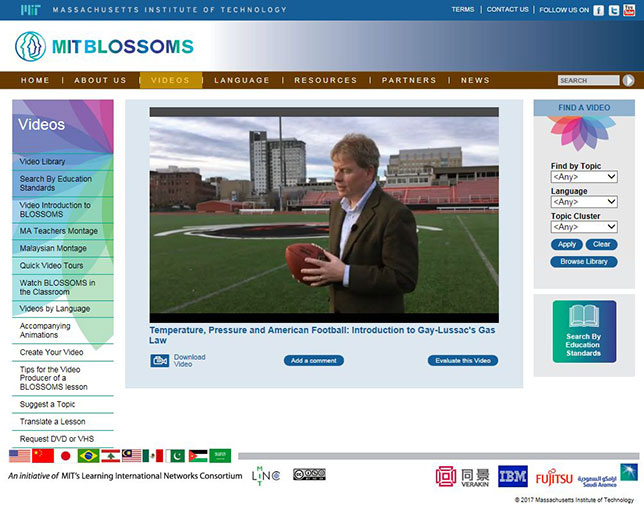
Now MIT has teamed up with a Massachusetts charter school system for regular access to the free website, which has about 200 videos in its online library for use in science and math courses. All of the lessons are intended to show the use of science and math to solve real-world scenarios. For example, another lesson, "The Fault in Our Cells," researches chemotherapy resistance; and "I am a Novice Marathoner" looks at how the human body produces energy through food digestion.
The agreement with Atlantis Charter School is the first of its kind for the "Blended Learning Open Source Science or Math Studies" or BLOSSOMS program. While other schools have used BLOSSOMS on an ad hoc basis, the latest arrangement will include professional development starting this month for teachers to help them improve their STEM instructional practices. The hope, according to a spokeswoman, is that the arrangement "will serve as a model for other schools across the state."
BLOSSOMS has been around since 2008, when MIT worked with educators in Jordan and Pakistan to create the site's first video lessons. Now teachers and scientists from around the world submit modules for BLOSSOMS. Resources cover math, engineering, physics, biology and chemistry and topics ranging from astronomy to the Pythagorean Theorem. Videos are available in about a dozen languages, as well as with subtitles and voiceovers.
For schools that lack adequate bandwidth or computing devices to download or stream the digital videos, BLOSSOMS lessons are also available in DVD and video formats for the cost of shipping.
BLOSSOMS is openly available on the MIT website here.
About the Author
Dian Schaffhauser is a former senior contributing editor for 1105 Media's education publications THE Journal, Campus Technology and Spaces4Learning.