Science, Engineering, Health Doctorates Find Career Success
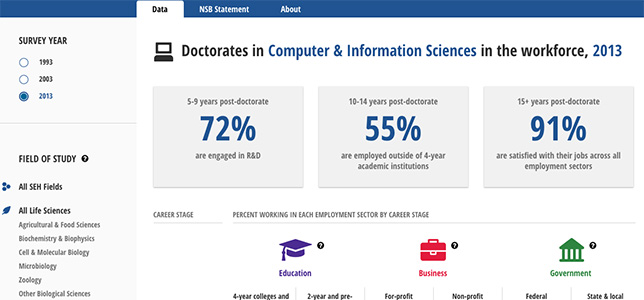
Image Credit: National Science Board.
The National Science Board, the National Science Foundation's policy arm, has released an interactive infographic that explores 25 years of science, engineering and health (SEH) doctoral pathways.
The NSB launched “a new tool for policymakers, educators, business leaders, students and others to asses the career opportunities for those with doctoral degrees in SEH fields,” according to an announcement. Using data from the NSF’s Survey of Doctorate Recipients, “the infographic allows users to see the number of doctorates employed in business, government and academic jobs and how career paths change over time.”
Users can look at demographics like gender, race and ethnicity, as well as characteristics such as job duties and job satisfaction. For individuals with doctorates in computer and information sciences in the workforce, for example, about 72 percent are engaged in research and development five to nine years post-doctorate. Further out, or 10 to 14 years post-doctorate, 55 percent are employed outside of a four-year institution. Finally, more than 15 years after earning a doctorate in computer and information sciences, 91 percent in the workforce are satisfied with their jobs.
Other key findings of the data include:
- More than 50 percent of SEH doctorates are employed in professions outside of academia within 10 to 14 years of graduating (continuing a 20-year trend);
- Nearly all SEH doctorates (more than 90 percent) reported job satisfaction more than 15 years after earning a doctorate;
- Individuals who are at the early part of their career and mid-career go into varying employment sectors. For example, the career pathways of social scientists are very different from that of engineers;
- The majority of recent doctoral graduates engage in research and development, regardless of employment sector; and
- As their careers progress, SEH doctorate holders engage in other activities like management.
NSB said in the announcement that the infographic expands on information in another report, "Revisiting the STEM Workforce," released two years ago. The previous report takes a look at the need for a STEM-capable workforce in today’s knowledge economy. It also argues that science and engineering degrees can be “passports” or entryways into a wide range of professions, with half of these degree holders working in non-STEM-related jobs.
The infographic can be viewed on the NSB site.
About the Author
Sri Ravipati is Web producer for THE Journal and Campus Technology. She can be reached at [email protected].