U of Michigan Awarded Google Grant to Expand After-School Robotics Program
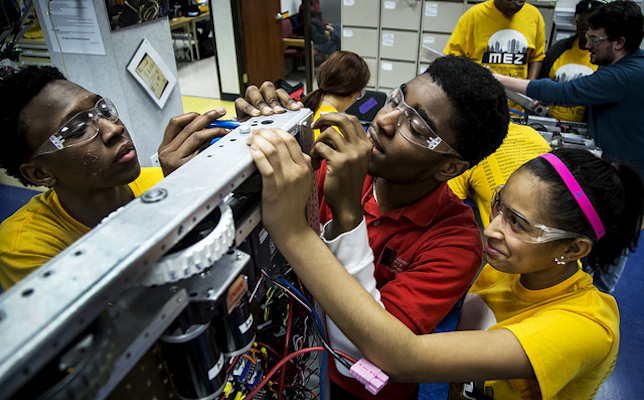
Students learn hands-on at the Michigan Engineering Zone. Image: University of Michigan.

More students in Detroit Public Schools will be participating in after-school programs in science and engineering, thanks to a $250,000 grant from Google to the Michigan Engineering Zone, a makerspace project of the University of Michigan College of Engineering.

The nearly 48,000-student school district is working with the MEZ as well as FIRST Robotics to get hundreds of students interested in pursuing STEM careers. The MEZ provides space, mentorship and tools to students as they build and test robots to compete in the FIRST Robotics competition.

The MEZ just wrapped up its eighth season with 18 high school FIRST teams and more than 275 students from the Detroit area. A majority of participating high school seniors were accepted into two- and four-year colleges and universities and plan to pursue careers in science or technology.

The grant from Google will “allow the program to build the infrastructure to expand by 33 percent to reach a total of 500 students per year,” according to a university statement.

Featured

  • A panel discussion from SXSW EDU 2025

    12 Ways to Dive into AI at SXSW EDU

    This March 9-12, the SXSW EDU Conference & Festival returns to Austin, TX, to celebrate innovation, experimentation, and learning across every stage of education.

  • glowing crystal ball with network connections

    Call for Opinions: 2026 Predictions for Higher Ed IT

    How will the technology landscape in higher education change in the coming year? We're inviting our readership to weigh in with their predictions, wishes, or worries for 2026.

  • glowing brain above stacked coins

    The Higher Ed Playbook for AI Affordability

    Fulfilling the promise of AI in higher education does not require massive budgets or radical reinvention. By leveraging existing infrastructure, embracing edge and localized AI, collaborating across institutions, and embedding AI thoughtfully across the enterprise, universities can move from experimentation to impact.

  • AI word on microchip and colorful light spread

    Microsoft Unveils Maia 200 Inference Chip to Cut AI Serving Costs

    Microsoft recently introduced Maia 200, a custom-built accelerator aimed at lowering the cost of running artificial intelligence workloads at cloud scale, as major providers look to curb soaring inference expenses and lessen dependence on Nvidia graphics processors.