Stampede2 Supercomputer Launches at Texas Advanced Computing Center
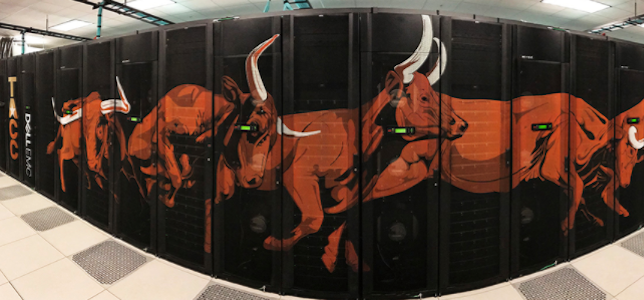
The University of Texas at Austin now runs the most powerful supercomputer at any higher education institution in the country. Housed at the Texas Advanced Computing Center (TACC), Stampede2 allows researchers nationwide across disciplines to answer questions that require high-performance computing power.
“Researchers will be able to use a wide range of applications, from large-scale simulations and data analysis using thousands of processors simultaneously, to smaller computations or interacting with Stampede2 through web-based community platforms,” according to a university statement.
The new supercomputer will be integrated into TACC’s ecosystem of 15-plus advanced computing systems, “providing access to long-term storage, scientific visualization, machine learning and cloud computing capabilities,” the UT Austin statement explained. “In addition to its massive scale, the new system will be among the first to employ the most advanced computer processor, memory, networking and storage technology from its industry partners Dell EMC, Intel and Seagate.”
Furthermore, partner institutions Clemson University, Cornell University, Indiana University, Ohio State University and the University of Colorado will continue advising TACC on cybersecurity matters.
Stampede2 is ranked the 12th most powerful supercomputer in the world, according to a recent TOP500 list. Since TACC’s goal is to reach a processing power equivalent to about 100,000 desktop computers, the next step for the system involves adding “hardware and processors, giving it a peak performance 18 petaflops, or 18 quadrillion mathematical operations per second,” the statement explained.
TACC previously operated the system’s predecessor, Stampede1, from 2013 to 2012 during which time it ran a total of 8 million compute jobs for researchers. Stampede2 aims to “double the peak performance memory, storage capacity and bandwidth of its predecessor,” while taking up half as much physical space and consuming half as much power.
The National Science Foundation — which supported Stampede1 — awarded $30 million for the project. The NSF-supported Extreme Science and Engineering Discovery Environment will allocate time on Stampede2 to researchers based on a competitive peer-review process.
To learn more about Stampede2, watch the video below.
Source: YouTube.
About the Author
Sri Ravipati is Web producer for THE Journal and Campus Technology. She can be reached at [email protected].