Multi-Campus VR Session Tours Remote Cave Art
- By Dian Schaffhauser
- 10/09/17
The University of Oklahoma and several other institutions recently held what they believe to be the first multi-state, multi-campus virtual reality class. The event, which occurred in mid-September, allowed participants from multiple locations to tour a remote cave with rare archaic art located on private land and therefore inaccessible to the public.
The initiative brought together 15 participants in all, from two separate physical locations at OU as well as two locations at the University of Central Oklahoma, the University of Arizona and Archaeology Southwest, a Tucson nonprofit conservation organization that finds "innovative ways" to share sites. The session leader worked from a home office. Everybody was connected in a shared virtual reality space.
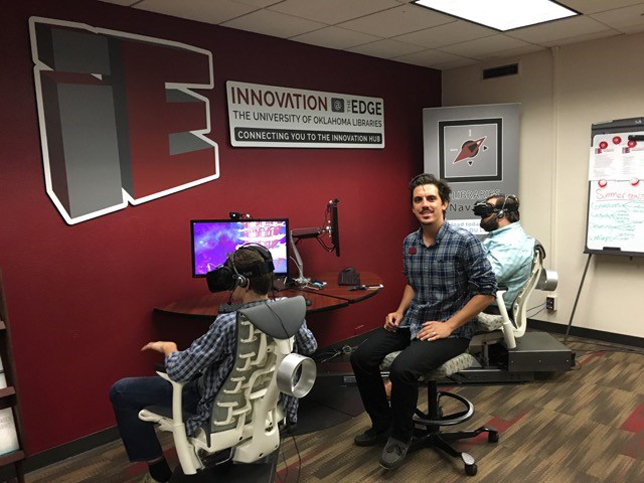
Matt Cook (middle), emerging technologies coordinator at the University of Oklahoma's Innovation @ the EDGE, served as the moderator for the cave tour event.
For this project, Archaeology SW was given permission by the private owner of the cave to send a photographer into the environment and take pictures — more than 700 of them. These images were processed using photogrammetry, a technique of 3D model development that combines the information from 2D digital images to produce 3D data points. The result is a highly detailed representation of physical structures and textures, which is used to build the VR experience, allowing others wearing VR headsets to experience the sensation of touring the cave.
The approach captured details of the cave's surface, including a number of ancient stone engravings, that could be analyzed digitally in ways that might be impossible in the real world, such as by adjusting the cave's lighting or zooming in on the cave's walls.
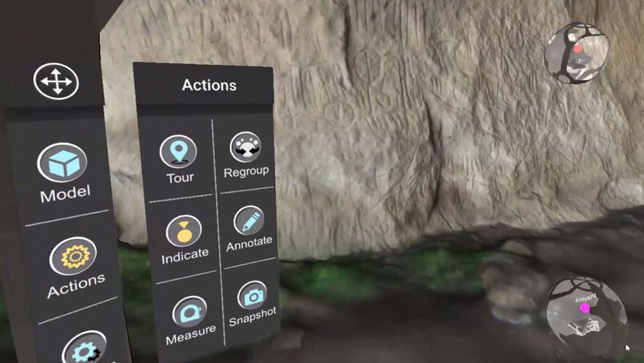
This screenshot was captured from a video recording of the VR cave exploration experience. To the left is a portion of the custom-coded control center for the VR application. The spheres are individual participants.
The project was undertaken by OU Libraries, which runs Innovation @ the EDGE, a flexible experimentation and innovation space that provides resources for 3D design and printing, VR and microelectronics experimentation and data skills development. (The institution was recently recognized as a Campus Technology Impact Award winner in the "Education Futurist" category.)
Doug Gann, Archaeology SW's preservation archaeologist, noted that while enhancements are needed, he was "completely blown away by how well the system works and is now looking forward to future developments."
Carl Grant, OU's associate dean of libraries and chief technology officer, said the work of Innovation @ the EDGE is "helping to show how the future of education might be reshaped using these exciting new technologies." As Grant noted, follow-up events are already being planned, featuring "a range of unique content, along with experts from universities nationwide. We are eager to move the adoption of this technology forward in classroom and research settings across the country."
A 47-minute video recording of the exploration is available on the University of Oklahoma website. A two-minute excerpt exploring a ceremonial space is available as well.
About the Author
Dian Schaffhauser is a former senior contributing editor for 1105 Media's education publications THE Journal, Campus Technology and Spaces4Learning.