Asynchronous Discussions, Group Projects Still Dominate in Online Courses
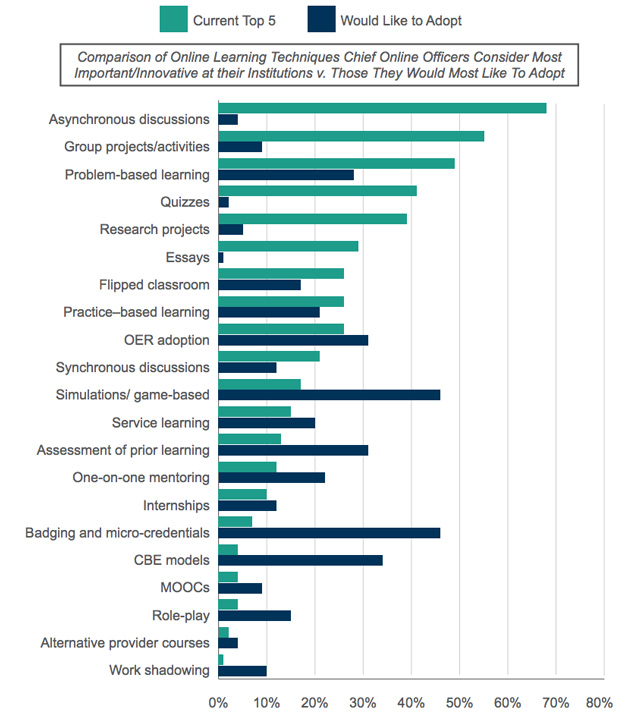
Asynchronous discussions and group projects are the most important techniques currently used for online learning, according to a new survey of online education leaders from Quality Matters and Eduventures Research. When asked which online learning methods were most important at their institutions, respondents pointed to those two activities first, followed by problem-based learning, quizzes and research projects.
The second annual Changing Landscape of Online Education (CHLOE 2) report surveyed 182 chief online officers (COOs) at U.S. colleges and universities about policies, practices and plans around online education. Researchers defined "chief online officer" as any position that manages online education for an institution — with responsibilities spanning course and program development, training, technology selection, support and oversight, budgeting, quality assurance, planning and policy.
Source: Chloe 2: The Changing Landscape of Online Education
Respondents were a bit more adventurous in the techniques they would most like to adopt in the future. Simulations/game-based learning and badging/micro-credentials were at the top of respondents' wish lists, followed by competency-based education models, open educational resources adoption and assessment of prior learning.
One particular learning technique had both a high adoption rate and a high level of future interest. As the report noted, "Problem-based learning is a stand-out …. The technique is the third most referenced among CHLOE respondents' current top five, but is also the sixth most desired for adoption. This may reflect the relative absence of distinctive market-facing pedagogies in today's online market, and a desire to lead with teaching and learning effectiveness rather than delivery mode or convenience."
The report also suggested that the flipped learning model may be in decline in fully online environments, as many respondents did not include the technique in their future plans. "It is interesting that the much-touted flipped classroom exhibits stronger contemporary than desired adoption. Perhaps the technique lends itself better to campus classrooms or to synchronous sessions that remain the exception in online learning," the researchers said.
Source: Chloe 2: The Changing Landscape of Online Education
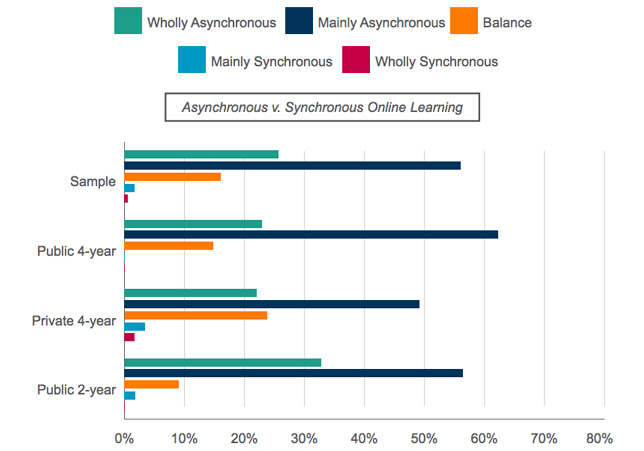
In fact, the survey found that asynchronous online learning is still the dominant model at most institutions. A full 82 percent of respondents said their online programs are wholly or mainly asynchronous. Why? Student and faculty preferences were the most common cited reasons. As the report explained, "Open comments clustered around the greater flexibility of asynchronous delivery for working adults (and for faculty) and across time zones, and a number of respondents argued that synchronous delivery mimics the physical campus in an uncritical way. Research, said some respondents, makes the case for asynchronous learning as a superior pedagogical experience."
The full report, which explores trends in the management of online education as well as the tools and techniques employed in online programs, is available on the Quality Matters site (registration required).
About the Author
Rhea Kelly is editor in chief for Campus Technology, THE Journal, and Spaces4Learning. She can be reached at [email protected].