New Remote Recorder Integrates with Panopto Video Software
- By Dian Schaffhauser
- 11/14/18
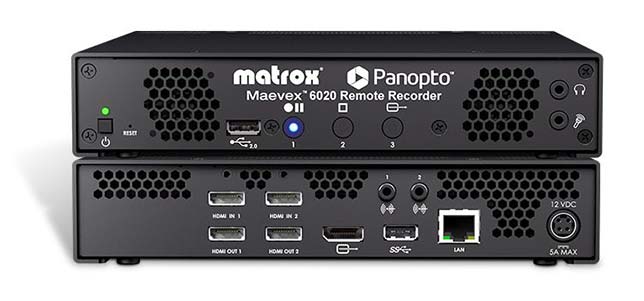
Two video companies that serve the education market, one making hardware and the other software, have produced a media capture appliance that takes advantage of their respective technologies. Panopto and Matrox Graphics announced the Matrox Maevex 6020 Remote Recorder, which will be available later this year in the United States.
The appliance was purpose-built to work with Panopto software for live streaming and video recording. For example, all videos are automatically published to Panopto's video content management system for on-demand playback. The unit was intended to appeal to schools seeking "minimal setup and configuration." It provides:
- Plug-and-play setup. The user connects power, network and video sources and the appliance automatically finds the Panopto server and registers as a remote recorder;
- Multi-channel high-definition video capture and live streaming. The Maevex 6020 works with Panopto's multi-channel video streaming engine, enabling viewers to watch dual HD feeds of the presenter and the content simultaneously;
- Near-silent operation. According to the companies, in typical use, the appliance registers less than 25dB, which means it can sit in the same room where the presentation is being delivered; and
- One-touch recording controls. Although users can schedule recurring or one-time event recording, they can also handle recording, pausing and stopping with a single control. A "busy light" indicates that the appliance is recording.
Uploaded videos are indexed for video search, and they can be edited using Panopto's web-based video editor. The dimensions of the unit are about nine inches wide by eight inches deep by two inches high. Pricing hasn't been announced yet.
"Panopto and Matrox share a belief that video solutions should adapt to the logistical requirements of any learning environment," said Eric Burns, co-founder and CEO of Panopto, in a statement. "Through our partnership, we're taking the next step toward this goal, providing customers with best-in-class video capture in a form factor that makes it an attractive option for any classroom, conference room, or auditorium."
About the Author
Dian Schaffhauser is a former senior contributing editor for 1105 Media's education publications THE Journal, Campus Technology and Spaces4Learning.