Cal State Long Beach Turns to Crowdsourcing for Next Strategic Plan
- By Dian Schaffhauser
- 12/04/18
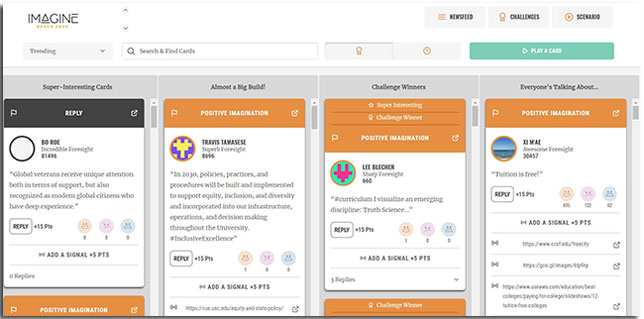
"Imagine Beach 2030" allows campus stakeholders to share ideas and provide feedback for the university's strategic planning efforts.
California State University Long Beach is turning to online crowdsourcing to help map out its future. Using a platform developed by game designer and researcher Jane McGonigal, "Imagine Beach 2030" invited participants to share their ideas and provide feedback on others' ideas during two days in November. Among the many contributions:
- Tapping the hospitality management and allied curriculum programs on campus to set up a food production lab to help feed those in need and thereby help combat student "food insecurity";
- Developing curriculum for an "emerging discipline" of "truth science";
- Creating a network for alumni to reach out to students with mentoring and internship opportunities;
- A focus in the College of Education on hiring and retaining a more diverse faculty "to better reflect the diverse student body";
- Providing alumni with a "specified number of courses" for up to 10 years for free as part of a lifelong learning initiative;
- Setting up "smarter classrooms," where desks could be lowered into the ground, making for a flat space that could be used for other purposes, such as events;
- Setting up centers where faculty could supervise and coach students working on projects for local nonprofits, giving participants "résumé-worthy experiences";
- Hosting graduate student "mixers" across disciplines to spark interdisciplinary activities and discussions; and
- Supporting the conversion of senior projects into "products in the real world" to help them pay off their student loans.
The project was instigated by President Jane Close Conoley, to mark the kickoff of a two-year planning process that will result in creation of the university's strategic plan for the next decade. To help in that effort, the institution turned to the Institute for the Future, a nonprofit that offers tools, research and programs to assist organizations in understanding trends and mapping out strategic actions.
The organization's platform, Foresight Engine, was created by McGonigal, who leads the Institute's games research. The program works like a card game. Participants read cards with "thought-provoking questions" and respond with their own cards to share ideas or add questions and comments about other participants' ideas. The object of the game is to gather as many cards as possible with different players' perspectives. People can play virtually or in person at on-campus events. Long Beach hosted almost two-dozen in-person play sessions, from spaces in the Office of Administration & Finance to University Housing.
In the next phase of the planning process, the results generated through the game will be consolidated and turned into a vision map. Next spring, the campus expects to host workshops and other events to share that map.
In the meantime, one winning suggestion that came out of the challenge was that the platform be used year-round to continue spreading ideas "quickly across campus, not just for 2030."
About the Author
Dian Schaffhauser is a former senior contributing editor for 1105 Media's education publications THE Journal, Campus Technology and Spaces4Learning.