About a Third of High Schoolers Tackle Dual Enrollment Classes
- By Dian Schaffhauser
- 03/08/19
A "data point" study by the National Center for Education Statistics reported that about a third of high school students in the 2009 to 2013 cohort took dual enrollment classes, mostly at their own schools. The research covered 23,000 people who were ninth graders in 2009 and were asked questions about the courses they took during their high school careers. The research project also examined transcripts for that period. The courses covered in the study don't include Advanced Placement or International Baccalaureate courses, which are intended to grant college credit if the student passes a standardized test.
The importance of dual enrollment is two-fold, researchers Azim Shivji and Sandra Wilson of Abt Associates mentioned. First, it's "promoted as a means to help students prepare and demonstrate their readiness for the rigors of college coursework"; and second, if the courses are transferable, they can help students and their families reduce the cost of college.
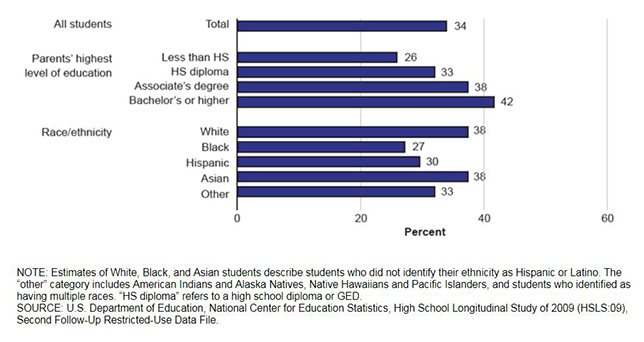
A breakdown of ninth-graders who took dual-credit courses during their high school years, beginning in 2009.
Thirty-four percent of students tackled courses for college credit. White and Asian students were more likely to do so than Hispanic or black students. Students whose parents had higher levels of education were also more likely to do so; in families where parents finished at least some college, the students were between 12 and 16 percentage points more likely to pursue dual enrollment opportunities than those whose parents didn't finish high school.
The most common location for students to take their college-credit courses was on their own high school campus, according to 80 percent of respondents; that was followed by a college campus, mentioned by 17 percent. Eight percent of students took online classes — and those in rural areas were more than twice as likely to do so than students in urban areas, 12 percent versus 5 percent. Six percent attended courses at a high school not their own.
About the Author
Dian Schaffhauser is a former senior contributing editor for 1105 Media's education publications THE Journal, Campus Technology and Spaces4Learning.