Gaming Computers and 2-in-1 Devices on the Rise as Overall Computing Market Slides
- By Dian Schaffhauser
- 06/13/19
While traditional personal computers and tablets are losing their luster worldwide, other types of computing devices are holding strong.
According to the latest worldwide PC shipment market report from tech analyst firm IDC, traditional notebooks and mobile workstations are seeing the biggest slide. That form factor is expected to drop by 9.1 percent annually between 2019 and 2023, shrinking from 18.4 percent of the market this year to 13.4 percent by 2023.
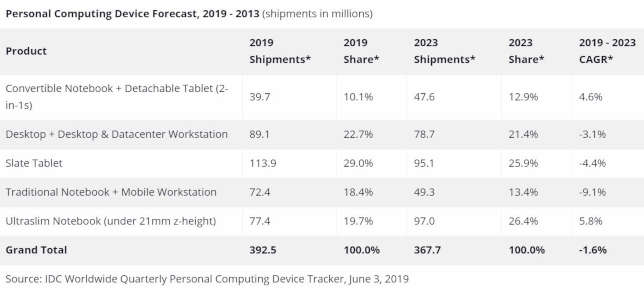
Slate tablets are also in a downward slide, losing 4.4 percent of market share each year over the next four years, followed by desktops and desktop workstations, which will decrease by 3.1 percent annually over that same period.
Growth is occurring in two categories: "ultraslim" notebooks (those under 21mm in thickness) and convertible notebooks and detachable tablets — 2-in-1s. The first category was projected to grow by 5.8 percent each year between now and 2023, claiming 26.4 percent of PC shipments, up from 19.7 percent; and the second category was expected to rise by 4.6 percent annually, to claim 12.9 percent of market share versus its current 10.1 percent.
IDC said it expected the introduction of new technologies to push prices up by nearly 3 percent in 2019. Those include "thinner bezels on notebook screens," which are driving those 2-in-1 sales, and "ongoing demand for gaming PCs."
On the business side, specifically, the company reported that enterprise organizations are already moving to replace their existing fleets of PCs before January 2020, when Microsoft ends official support for Windows 7.
Many of these enterprises, "are also looking to modernize their workforce by deploying ultraslim notebooks and 2-in-1 form factors," said Research Manager Jitesh Ubrani in a statement. "Not only are these devices expected to mobilize the workforce, but providing more brand and form factor options has proven successful at bringing younger talent into the work force."
On the consumer side, "smartphones continue to be top of mind for consumers when it comes to new device purchases, and arguably the rapid adoption of large screen smartphones has resulted in consumers doing less on their PC or tablet and more on their phone," added Program Vice President Ryan Reith. Where IDC was seeing growth among consumers was on gaming PCs, "including lower-priced options," and "thin and light notebooks at more attractive price points."
While IDC anticipated shipments to total 392.5 million this year, by 2023, that was expected to fall to 367.7 million, an overall reduction of 1.6 percent.
About the Author
Dian Schaffhauser is a former senior contributing editor for 1105 Media's education publications THE Journal, Campus Technology and Spaces4Learning.