Education Helping to Drive Surge in AR & VR

Augmented and virtual reality will see massive growth in the next five years, driven in large part by both K–12 and post-secondary education.

According to a new forecast from market research firm IDC, AR and VR will grow at a compound annual growth rate (CAGR) of 78.3 percent for the next five years to reach nearly 10 times the scale it's expected to hit this year — from $16.8 billion in 2019 to $160 billion in 2023.

According to IDC, two of the top five use cases for growth are in the education sector:

  • Lab and field work in higher education, which is expected to grow at a CAGR of 183.4 percent over the forecast period; and

  • Lab and field work in K–12, which is expected to grow at a CAGR of 146.3 percent.
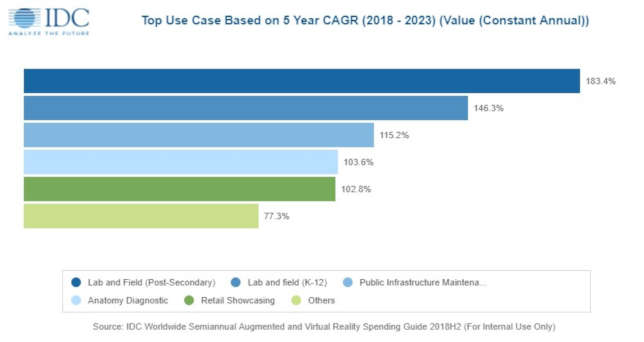
Education Helping to Drive Massive Surge in AR & VR 

The United States will not lead in either spending or growth. China will spend the most on AR and VR technology during the forecast period. The United States will come in second. The two combined will account for about three-quarters of the world’s spending on this technology category.

The fastest growth will be seen in Western Europe, followed by the United States and China.

According to IDC: “Hardware will account for more than half of all AR/VR spending throughout the forecast, followed by software and services. Strong spending growth (189.2 percent CAGR) for AR viewers will make this the largest hardware category by the end of the forecast, followed by VR host devices. AR software will be the second fastest growing category, enabling it to overtake VR software spending by 2022. Services spending will be driven by strong growth from AR consulting services, AR custom application development, and AR systems integration.”

For more information, go to IDC’s Worldwide Semiannual Augmented and Virtual Reality Spending Guide.

About the Author

David Nagel is the former editorial director of 1105 Media's Education Group and editor-in-chief of THE Journal, STEAM Universe, and Spaces4Learning. A 30-year publishing veteran, Nagel has led or contributed to dozens of technology, art, marketing, media, and business publications.

He can be reached at [email protected]. You can also connect with him on LinkedIn at https://www.linkedin.com/in/davidrnagel/ .


Featured

  • Interface buttons of Generative AI tool

    Report: No Foolproof Method Exists for Detecting AI-Generated Media

    Microsoft has released a new research report warning that no single technology can reliably distinguish AI-generated content from authentic media, and that deepening reliance on any one method risks misleading the public.

  • illustration of people collaborating around large interlocking gears and data charts

    Why ERP and AI Initiatives Stall at the Execution Layer: A CIO Perspective

    Higher education institutions are investing heavily in ERP modernization, analytics, and AI-driven capabilities. Yet even with these investments, many are running into the same issue: turning insight into coordinated, timely action.

  • large group of college students sitting on an academic quad

    Student Readiness: Learning to Learn

    Melissa Loble, Instructure's chief academic officer, recommends a focus on 'readiness' as a broader concept as we try to understand how to build meaningful education experiences that can form a bridge from the university to the workplace. Here, we ask Loble what readiness is and how to offer students the ability to 'learn to learn'.

  • digital lock on a virtual background

    Encryptionless Extortion on the Rise as Ransomware Groups Shift Tactics

    Ransomware attacks continued to climb in 2025 as attackers increasingly timed operations around year-end staffing gaps and shifted away from traditional file encryption, according to new research from NordStellar.