New MIT Supercomputer Is Designed for AI
The TX-GAIA combines nearly 100 Intel processors and 900 Nvidia GPU accelerators to create a system optimized for artificial intelligence applications.
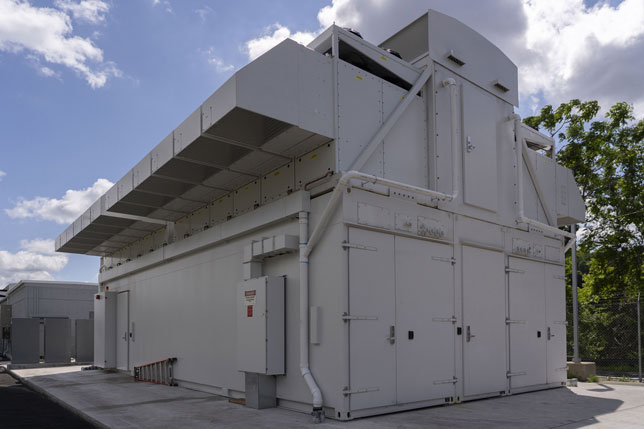
TX-GAIA is housed inside of a new EcoPOD, manufactured by Hewlett Packard Enterprise, at the site of the Lincoln Laboratory Supercomputing Center in Holyoke, Massachusetts. Photo: Glen Cooper.
The Lincoln Laboratory Supercomputing Center (LLSC) is getting a major upgrade. The Massachusetts Institute of Technology affiliated organization has a new supercomputer called TX-GAIA that was built by Hewlett Packard Enterprise.
The system leverages nearly 100 Intel processors and 900 Nvidia GPU accelerators to combine high-performance computing with hardware optimized for AI. TX-GAIA was built based on the HPE Apollo system. The supercomputer is currently ranked as the most powerful artificial intelligence supercomputer at any university in the world by TOP500.
"We are thrilled by the opportunity to enable researchers across Lincoln and MIT to achieve incredible scientific and engineering breakthroughs," said Jeremy Kepner, an LLSC fellow who heads the LLSC. "TX-GAIA will play a large role in supporting AI, physical simulation and data analysis across all Laboratory missions."
TX-GAIA is specifically designed to perform deep neural network operations (DNN) quickly. DNNs are currently used for speech recognition and computer vision applications, such as powering Amazon's Alexa or helping self-driving cars recognize objects in their surroundings.
The latest system will also be used to crunch terabytes of data to train machine learning algorithms and support LLSC's research and development initiatives. Scientists at LLSC are working to find new ways to improve weather forecasting, accelerate medical data analysis, build autonomous systems, design synthetic DNA and develop new materials and devices.
TX-GAIA is housed in a new modular data center at the LLSC's green, hydroelectrically powered site in Holyoke, MA.
About the Author
 Sara Friedman is a reporter/producer for Campus Technology, THE Journal and STEAM Universe covering education policy and a wide range of other public-sector IT topics.
Friedman is a graduate of Ithaca College, where she studied journalism, politics and international communications.
Friedman can be contacted at [email protected] or follow her on Twitter @SaraEFriedman.
Click here for previous articles by Friedman.