Updated Johns Hopkins Coronavirus Map Adds Local Data
coronavirus map

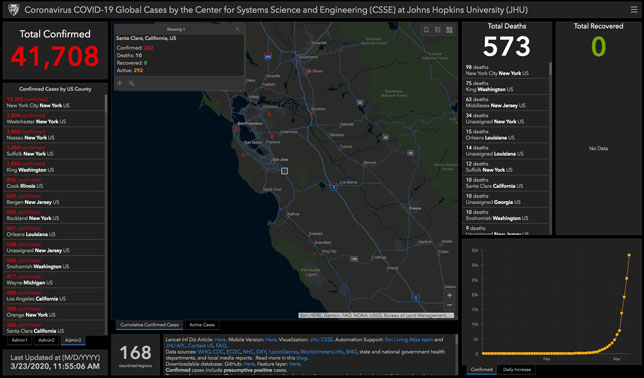
Screen capture of coronavirus data from Santa Clara County, CA, as of March 23, 2020

Johns Hopkins University has upgraded its COVID-19 tracking map to include local data from every city and county in the United States. When users zoom in on the U.S. map, they can now click on each county to display the numbers of confirmed cases, active cases, deaths and recoveries for that jurisdiction.

State- and local-level information can also be viewed through the vertical country column on the left-hand side of the map; when users click on "U.S." in that column, they can then navigate to state and local data via the "Admin" tabs at the bottom of the column.

The update will also "allow for adding features later that will deliver broader insights about the pandemic," according to the university, and all the map data continues to be freely available in a GitHub repository.

The map and additional resources are available on Johns Hopkins' online portal.

About the Author

Rhea Kelly is editor in chief for Campus Technology, THE Journal, and Spaces4Learning. She can be reached at [email protected].

Featured

  • artificial intelligence on laptop

    OpenAI to Combine AI Products into Desktop 'Superapp'

    OpenAI is reportedly developing a desktop application that would combine several of its emerging AI products into a single platform, according to reports, marking the latest step in the company's effort to transform ChatGPT from a standalone chatbot into a broader productivity and automation environment.

  • Abstract digital data stream with binary code and colorful light trails

    Microsoft Releases Open Source AI Safety Tools for Agent Development

    Microsoft released RAMPART and Clarity as open-source projects intended to help developers test AI agents earlier in the software lifecycle and turn red-team findings into repeatable engineering checks.

  • abstract illustration of artificial intelligence

    CSU Shares AI Learnings in Systemwide Survey

    In a systemwide survey of more than 94,000 faculty, staff, and students, California State University recently documented widespread AI use across its 22 campuses.

  • Profile silhouette of a person thoughtfully touching their chin, overlaid with transparent data visualizations and digital interface elements suggesting artificial intelligence and analytics.

    The Institutional Knowledge Shift Is Reshaping Higher Ed IT

    Higher education IT leaders are navigating a quiet but consequential transition: Experienced team members are retiring or leaving for private-sector roles, and the teams replacing them are smaller, newer, and often stretched thin. The result is a structural shift in how technology decisions are made, executed, and sustained.