Robotics Education Lagging Behind Demand, Surveys Find
- By Kate Lucariello
- 09/29/22
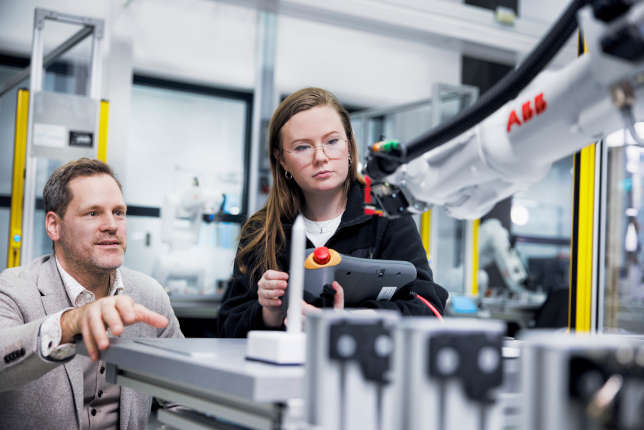
Swiss-based
automation technology company ABB
announced recently that robotics and automation training are lagging
behind increased global demand, according to two surveys it conducted
this year on supply chain and education.
While
80% of education professionals say robotics and automation skill sets
will become crucial to employment in the near future, only one in
four institutions worldwide are teaching them, the surveys found.
This is in stark contrast to results showing that on average 70% of
U.S. and European businesses plan to invest in robotics and
automation over the next three years, driven by supply chain issues.
Subsequently, 74% of European and 70% of U.S. businesses are gearing
up to reshore or nearshore their manufacturing back to their home or
adjacent countries to reduce costs and improve delivery by relying on
automation to accomplish it.
“We
need significant investment in continuous education to prepare our
existing and future workforce to thrive in an age of robotics and
automation, important not only to prepare for the widespread shifts
we are seeing, but to create prosperous societies going forward,”
said Sam Atiya, president of ABB’s Robotics & Discrete
Automation Business.
ABB
partners with education institutions such as Illinois State
University, Normal, in order to fill the gap. The Department of
Technology employs ABB’s RobotStudio, a programming software that
trains students to create and test robotic solutions virtually. “One
trend that I think we're seeing clearly is an increased demand for
our graduates,” said Kevin Devine, College of Applied Science and
Technology professor. “The industry is clamoring right now for
qualified people and we're having a lot of trouble meeting that
need.”
ABB
has added new Robotics and Education program training centers to its
40 existing ones, with the latest located in Austria. These centers
have educated more than 30,000 students from schools, colleges, and
universities, as well as apprentices and workers each year, ABB said
in a release, through more than 100 global partnerships.
“Businesses
need to join forces, cooperating with education institutions and
governments to ensure that society is prepared for jobs of the
future,” Atiya added. “Only through this can we fully utilize
flexible automation and unlock value from the ongoing
re-industrialization.”
To
learn more, visit ABB’s Robotics
in Education page.
About the Author
Kate Lucariello is a former newspaper editor, EAST Lab high school teacher and college English teacher.