Occuspace Expands Occupancy Monitoring to More Colleges and Universities
- By Kate Lucariello
- 11/17/22
Occupancy technology company Occuspace has announced its expansion into several colleges and universities in the U.S. and Canada to report real-time and historical space-usage data for campus buildings to anyone using their Waitz mobile app, especially useful to students seeking places to study, the company said.
In a survey done in October 2022, 85% of Occuspace customers reported using the data to gauge the use of their physical spaces. Vanderbilt University reported "an overwhelming positive response from students using the Waitz app to navigate busy times in the dining halls and libraries," said Mark Brown, director of business services technology at the university. In addition to Vanderbilt, Occuspace technology has recently been installed at Purdue, Columbia, UCLA, and several others. Read a case study of how UCLA uses Occuspace to manage traffic in 11 dining halls. To see the software in real-time action, visit the North Carolina State University page: How Busy is the Hill Library?
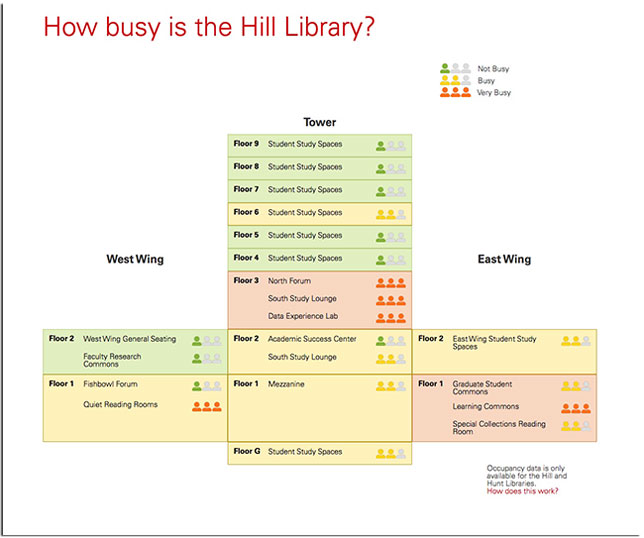
Occuspace data in action at North Carolina State University's Hill Library
Occuspace sensors are plugged into regular wall units and scan for bluetooth and WiFi signal activity in an area from laptops, cell phones, wearables, and other connected devices. Algorithms maintain 90% accuracy and account for those who may have several devices. Individuals are not tracked, the company said. The approximate annual cost for less than 5,000 square feet is $600. Cost is based on the number of sensors needed depending on square footage, with one sensor for every 2,500 to 5,000 square feet, based on layout. Read more about how the technology works and use the approximate cost calculator.
For more information, visit the Occuspace home page.
About the Author
Kate Lucariello is a former newspaper editor, EAST Lab high school teacher and college English teacher.