Gartner Predicts Wave of Abandoned AI Projects
Organizations that made significant early bets on AI may be in for a letdown, Gartner warned in a recent report.
Having placed the cloud AI services market in the "trough of disillusionment" stage, the research firm is now forecasting a ghost town of failed AI business projects.
"At least 30% of generative AI (GenAI) projects will be abandoned after proof of concept by the end of 2025, due to poor data quality, inadequate risk controls, escalating costs or unclear business value," Gartner said this week in a news release from an event in Australia.
AI hit rock bottom in the company's Hype Cycle earlier this month. At the time, Gartner said, "Vendors and end users of these services have experienced problems with service capacity, reliability, model update frequency and cost fluctuation, which may, however, be considered growing pains."
Now, the firm is piling on the AI negativity.
"After last year's hype, executives are impatient to see returns on GenAI investments, yet organizations are struggling to prove and realize value. As the scope of initiatives widen, the financial burden of developing and deploying GenAI models is increasingly felt," said analyst Rita Sallam at the Sydney event.
One major challenge, she said, is justifying the big investment in generative AI to enhance productivity, which can be hard to relate to financial benefit.
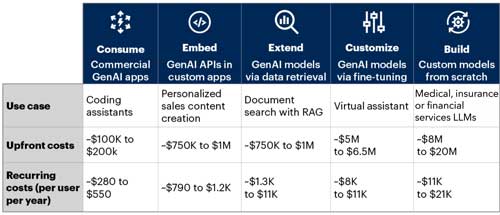
While she said organizations are trying to transform their business models with generative AI, that takes a lot of money, with the graphic below showing costs can range from $5 million to $20 million.
 [Click on image for larger view.]
Costs Incurred in Different GenAI Deployment Approaches. (Source: Gartner)
[Click on image for larger view.]
Costs Incurred in Different GenAI Deployment Approaches. (Source: Gartner)
Gartner used the news release to point to its "Calculating the ROI on GenAI Business Model Innovation" (requires account) report for help, along with the webinar, "What Mature Organizations Do Differently for AI Success."
"If the business outcomes meet or exceed expectations, it presents an opportunity to expand investments by scaling GenAI innovation and usage across a broader user base, or implementing it in additional business divisions. However, if they fall short, it may be necessary to explore alternative innovation scenarios. These insights help organizations strategically allocate resources and determine the most effective path forward," Sallam said.
About the Author
David Ramel is an editor and writer at Converge 360.