Report: AI Is Moving Faster than Data Trust
Veeam Software says enterprise AI adoption is advancing faster than the data governance, visibility, and recovery controls needed to support it, creating what the company calls a "Data and AI Trust Gap."
The company unveiled the findings in its new Data & AI Trust Gap report, based on a global survey of 600 senior executives across various industries. Veeam's central finding is that AI adoption itself is not the main problem: 88% of organizations are already using or piloting AI agents, but only 7% qualify as "truly AI-ready" and 95% say data challenges have already slowed AI progress.
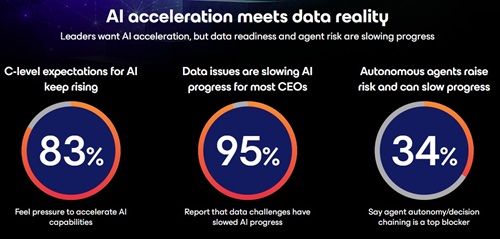 [Click on image for larger view.] Key Findings (source: Veeam).
"Most organizations don't have an AI adoption problem; they have an AI trust problem," said Anand Eswaran, CEO of Veeam, in a statement. "The first phase of AI was defined by infrastructure investment, experimentation, and acceleration. The next phase will be defined by trust. With the widespread adoption of autonomous AI agents operating at machine speed, the question transitions from whether you can use AI, to whether you can ensure all your data is secure, governed, compliant and resilient. And should something go wrong, can you recover with precision? That's how you accelerate safe AI at scale without accelerating reputational and operational risk."
When AI Fails, It May Not Look Like Downtime
For cloud and infrastructure teams, the report's most operationally significant finding is Veeam's warning that AI failures may not resemble traditional outages. As AI systems become more autonomous, the company said risk is shifting from broad system downtime toward data-level failures that are harder to detect, explain, and contain.
That has implications for data protection and recovery strategies. If an AI agent changes data, exposes sensitive information, triggers an incorrect workflow, or influences a business decision, recovery may require more than restoring a virtual machine, database, or application environment. It may require knowing which data was used, which systems were accessed, what actions were taken, and which decisions were influenced.
Veeam found that, among organizations already running AI, only 22% could identify within minutes which data the system used. Twenty-nine percent could identify which systems it accessed, 25% could identify what actions it took, and 24% could identify what decisions it influenced. Only 40% of leaders said they are very confident they can isolate and precisely reverse an agentic AI failure.
That finding connects the AI discussion directly to data resilience. Veeam said machine-speed mistakes can outpace detection, requiring resilience to evolve from broad recovery toward precision recovery — restoring only what is affected rather than rolling back entire environments.
Small AI-Ready Group Reports Measurable Results
The report defines AI readiness around three building blocks: ambition, visibility, and governance. Organizations need clear goals for data and AI, a reliable view of what data they hold and where it resides, and governance structures that allow data to be used safely and compliantly.
Only 7% of organizations surveyed have all three building blocks in place. Among that group, however, 97% reported significant, formally quantified business outcomes from the past year. Veeam said the gap is not as wide as the 7% figure may suggest, because 60% of organizations have at least two of the three elements in place.
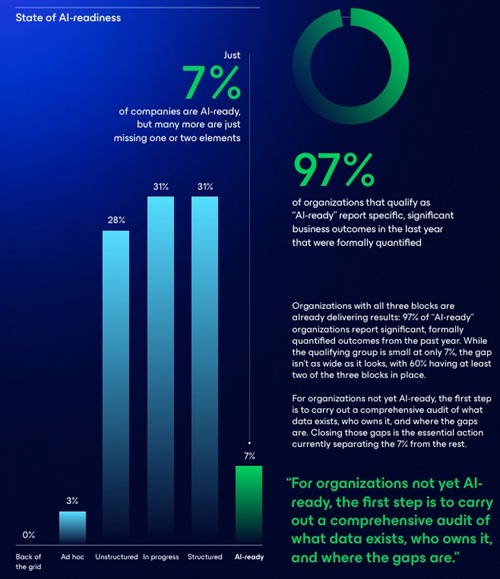 [Click on image for larger view.] State of AI Readiness (source: Veeam).
The report also ties trusted data to revenue and efficiency expectations. Veeam said 48% of CEOs believe trusted, secure, and compliant data could unlock more than 25% revenue growth. Across all leaders surveyed, the report says 38% believe making all data secure and compliant could boost revenue or efficiency by more than a quarter.
At the same time, the data foundation remains incomplete for many organizations. Seventy-nine percent of C-suite respondents said their organization's data needs to be more up to date, 74% said it needs to be more accurate and 71% said it needs to be more accessible.
Governance and Ownership Are Fragmented
The report also identifies a leadership and accountability gap around AI and data. Veeam said 65% of CEOs believe they have a full AI inventory, compared with 48% of technical leaders cited in the press release. In the report's role-specific breakdown, 44% of CISOs and 52% of CIOs said their organization's AI inventory is complete and reliable.
The report also found that ownership of agentic AI risk is distributed across multiple functions. Thirty-five percent of respondents said primary responsibility for what AI agents do sits with an AI or innovation executive, 29% pointed to technology or engineering teams, 14% to the data function, 11% to the CISO, 7% to shared responsibility across functions, and 3% to technical teams.
"When 'everyone owns it,' no one can decisively set policy, enforce controls, or prove outcomes," Veeam said.
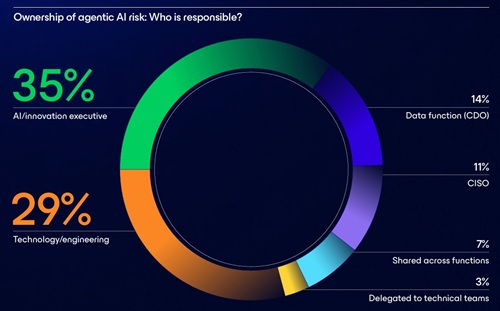 [Click on image for larger view.] Ownership of Agentic AI Risk (source: Veeam).
Veeam said outcomes improve when ownership is clearly defined. According to the release, organizations where CISOs own AI agent risk are 24% more likely to detect rogue AI behavior, while organizations relying on shared ownership are 47% less likely to detect rogue AI behavior.
Shadow AI Widens the Data Visibility Gap
The report also points to shadow AI as another factor complicating data visibility and governance. Veeam said 95% of organizations report unauthorized AI use within their organization, while 93% view it as a significant risk. Yet only 25% provide approved alternatives for all employees.
The most common response to shadow AI was general AI training, cited by 57% of respondents. Other responses included implementing data access controls at 48%, monitoring the network at 46%, creating new policies at 43%, reminding staff of existing policies at 31%, asking staff to report other staff using shadow AI at 29%, and providing access to approved AI tools at 25%.
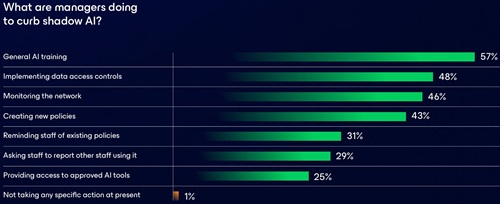 [Click on image for larger view.] Shadow AI Response (source: Veeam).
Veeam said 44% of respondents associate shadow AI with increased cyber risk, while 47% identify maintaining audit trails for AI decisions as their top compliance concern.
Survey Scope
The research was conducted from March 16 to April 6, 2026, among 600 senior executives across North America, Europe and Asia-Pacific. Respondents included CEOs, CIOs, CISOs, CDOs and other senior leaders responsible for data, AI, technology and compliance.
"The findings here leave no room for doubt. When 95% of executives say data challenges are already slowing their AI progress, the bottleneck isn't the model — it's trusted, governed, recoverable data," Eswaran said. "Veeam is building the Data and AI Trust layer to give enterprises the visibility, control and precision recovery needed to scale AI safely and deliver real business value."
The full report is available here on the Veeam site (registration required).