Microsoft Discovery Platform Brings Agentic AI to Scientific Research
Microsoft has moved its Discovery platform into general availability, calling the service a production-ready environment for scientists and researchers that want to apply AI agents. The platform is designed to help coordinate data analysis, hypothesis generation, experimentation, and knowledge management through a collection of specialized AI agents.
The GA announcement at Build 2026 follows Microsoft's broader effort to embed agentic AI across its portfolio and reflects growing interest in using AI systems to accelerate scientific and industrial innovation. Built around a graph-based knowledge engine, Microsoft Discovery aims to connect proprietary research data with external scientific information so AI agents can reason across complex relationships, evaluate competing findings and support iterative research processes.
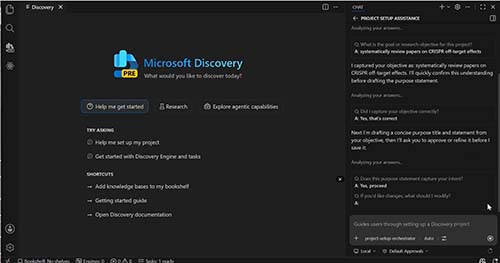
A preview of the Microsoft Discovery app was also launched, a local desktop experience aimed at researchers, students, academic labs, and scientific teams that may not be ready for a full enterprise deployment.
 [Click on image for larger view.]
Figure 1. Welcome screen for Microsoft Discovery app (currently in preview).
The broader pitch is familiar from Microsoft's recent AI messaging: Agents should not only answer questions, but also plan, reason, use tools, and work through multistep processes. In this case, Microsoft is applying that approach to R&D, where teams often have to move through repeated cycles of hypothesis, experimentation, validation, and review.
[Click on image for larger view.]
Figure 1. Welcome screen for Microsoft Discovery app (currently in preview).
The broader pitch is familiar from Microsoft's recent AI messaging: Agents should not only answer questions, but also plan, reason, use tools, and work through multistep processes. In this case, Microsoft is applying that approach to R&D, where teams often have to move through repeated cycles of hypothesis, experimentation, validation, and review.
At the center of the platform is the Microsoft Discovery Engine, which Microsoft said supports the core loop of scientific work by helping teams move from evidence to hypotheses, then through execution, analysis, and additional iteration. The company described the general availability release as a "production-ready platform" for R&D environments.
For enterprise IT and research organizations, the key issue will be governance. Microsoft is positioning Discovery as a system that can connect to institutional knowledge, domain-specific data, simulation tools, and external scientific information while keeping outputs reviewable and workflows reproducible. The company said the platform is designed to keep "human judgment" at the center of research decisions.
The new Microsoft Discovery app preview is meant to lower the barrier to entry. The app can be downloaded from GitHub and used with a GitHub Copilot account. Microsoft said it gives smaller teams a way to begin exploring literature review, hypothesis generation, scientific reasoning, and iterative experimentation before moving work into the broader Microsoft Discovery platform.
Microsoft highlighted several early use cases from research institutions and industry partners.
Yale Engineering used the Discovery Engine in work related to small molecule design for grid-scale aqueous organic redox flow batteries. David Kwabi, associate professor at Yale, said the work combines human-led experimentation with AI's ability to explore large chemical design spaces.
Pacific Northwest National Laboratory is working with Microsoft Discovery in energy storage and biosystems engineering, including self-driving scientific workflows that connect AI agents with laboratory automation. Ginkgo Bioworks is also working with Microsoft on biological discovery, with specialized agents that can analyze datasets, generate hypotheses, and design experiments.
Microsoft also pointed to commercial and industrial use cases. BHP is using Discovery to study advanced copper leaching methods, while Syensqo is using agentic AI in work tied to next-generation heat transfer fluids for semiconductor manufacturing. GSK is exploring Discovery for drug development workflows.
The announcement comes as Microsoft continues to expand its agent strategy across Azure, Microsoft Foundry, GitHub, and Microsoft 365. With Discovery, the company is targeting a narrower but potentially high-value audience: organizations where research cycles are expensive, data-heavy, and subject to regulatory or scientific review.
Microsoft Discovery is generally available now. The Microsoft Discovery app is available in preview, and Microsoft said preview features may change before final release. For more information, visit the Microsoft blog.