Research: Enterprise AI Workloads Are Tipping Toward Private Cloud
Broadcom is framing its latest private cloud research around what it calls an enterprise AI "tipping point," saying production AI workloads are changing how organizations evaluate cloud architecture, cost, security, and governance.
The company's Private Cloud Outlook 2026 report, titled "The AI Tipping Point," is based on a global survey of 1,800 senior IT decision-makers across the Americas, Europe and Asia-Pacific. In a news announcement, Broadcom asserted that the AI experimentation phase is over and that private cloud is where enterprise AI workloads are being deployed for security and scale. The company said the shift is being shaped by "costs, complexity, and control" as enterprises move AI workloads into production.
Production AI Shifts Toward Private Cloud
Broadcom said 56% of enterprises surveyed are running or planning to run production AI inferencing on private cloud. The company also said public cloud use for the same workloads fell 15 percentage points year over year, from 56% to 41%.
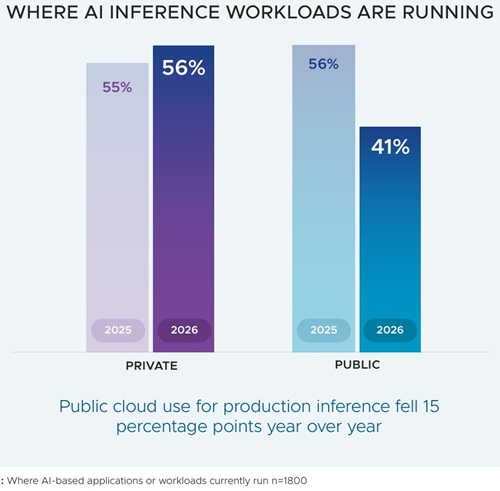 [Click on image for larger view.] Where AI-based Applications or Workloads Currently Run (source: Broadcom).
The report says public cloud remains part of enterprise IT strategy for experimentation, elastic capacity, and specialized services. But Broadcom said AI production workloads introduce sustained compute demand, sensitive data flows, governance requirements, and performance expectations that can expose limits in a purely public cloud approach.
The shift is also reflected in repatriation data. Broadcom said 83% of enterprises are considering or have already repatriated workloads from public cloud to private cloud, and 50% have already repatriated some workloads. In 2025, the corresponding figures were 69% considering or already repatriating and 35% already having done so.
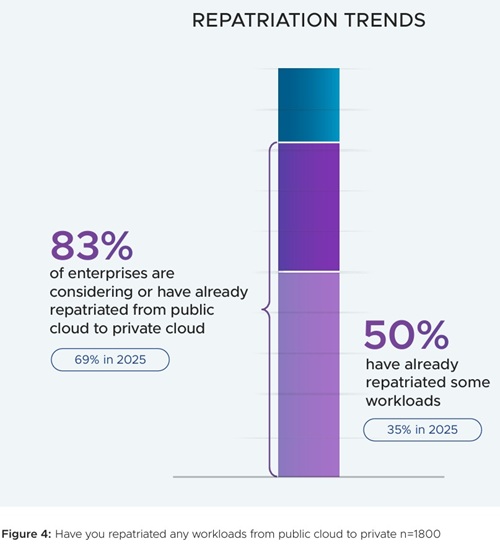 [Click on image for larger view.] Repatriation Trends for AI-based Applications or Workloads (source: Broadcom).
AI appeared as a repatriation category for the first time in the 2026 study. Broadcom said 43% of organizations repatriating workloads are moving AI training, large language models, and inference from public cloud to private cloud.
In a Broadcom blog post on the report, Prashanth Shenoy, vice president of marketing for the VMware Cloud Foundation Division at Broadcom, wrote that "as enterprises look to scale, the direction has changed." The same post said enterprise AI "has found its infrastructure home. And it is private cloud."
Cost Replaces Security as Top Public Cloud Concern
Broadcom said cost has overtaken security as the top public cloud concern in the 2026 study. According to the report, 31% of respondents cited cost management as a leading public cloud challenge, up from 26% in 2025.
The report also said 97% of surveyed IT leaders believe some portion of their public cloud spend is wasted, while 52% said that waste exceeds 25%. Broadcom linked those findings to AI infrastructure pressures, including compute, storage, bandwidth, GPU pricing, data movement fees, and unpredictable usage patterns.
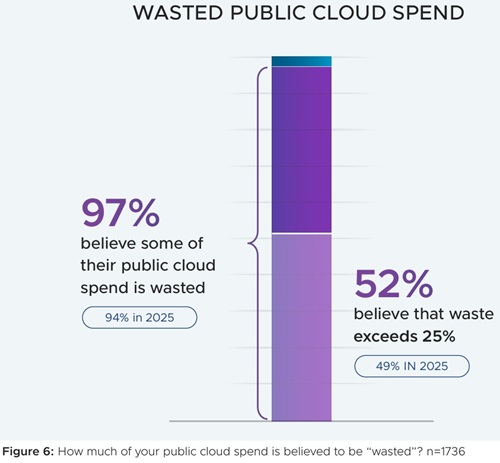 [Click on image for larger view.] Wasted Public Cloud Spend (source: Broadcom).
Broadcom said 62% of IT leaders are very or extremely concerned about generative and agentic AI infrastructure costs. The report said cost predictability is now the second-biggest driver for repatriation, cited by 39% of organizations. Security and compliance remained the top driver at 51%, and performance was also cited by 39%.
Shenoy said in the Broadcom announcement, "As enterprises move from pilots to running AI at production scale, infrastructure and operational costs spike, security gaps surface, and complexity compounds. The research is clear: Enterprises increasingly prefer private cloud for production AI."
Security, Sovereignty and Governance Shape Placement
Security and compliance still play a central role in workload placement decisions. Broadcom said 32% of respondents chose security and compliance as the single most important factor in workload placement, ahead of cost, performance and scalability.
The report said AI is adding new requirements to enterprise infrastructure. Data protection and privacy were cited by 37% of respondents as the biggest new requirements introduced by AI, followed by security and control at 36%.
Broadcom also said geopolitical and regulatory factors are affecting enterprise IT strategy and operations. According to the report, 86% of IT leaders said those factors are affecting their strategy and operations. Data sovereignty and residency requirements were the top geopolitical concern, cited by 54% of respondents.
The report defines private cloud as dedicated infrastructure for a single organization, potentially owned or managed by the organization, a third party or both. Examples listed in the report include VMware Cloud Foundation and Red Hat OpenShift. The report defines public cloud as shared infrastructure run by a third-party provider, with examples including AWS, Azure, and Google Cloud, and says SaaS is excluded.
AI Readiness Extends to Modernization
In a separate Broadcom post on AI readiness, the company connected the private cloud findings to application modernization and platform engineering. That post said 57% of enterprise IT teams surveyed reported that their top modernization approach is adding AI capabilities to existing applications.
The same post said 72% of enterprises have modernized less than half of their application portfolio. Broadcom said the old model of sequential transformation, in which modernization comes first and AI comes second, does not fit the operating reality most IT teams are navigating.
Broadcom also said surveyed organizations expressed confidence in private cloud capabilities. The company said 93% agree that private cloud delivers the reliability business-critical applications demand, and 92% said it provides the financial transparency and predictable costs needed to govern AI infrastructure spending.
The Private Cloud Outlook report says private cloud spending plans are increasing. Broadcom said intent to increase private cloud spend over three years rose from 51% to 72%, while the priority to build new private cloud workloads climbed from 53% to 58%.
Survey Scope and Methodology
The report said Broadcom partnered with Radius Tech for the research. The sample included 1,800 senior IT decision-makers worldwide, with 600 participants each from North America, Europe, and Asia-Pacific. Countries listed in the methodology include the United States, Brazil, the United Kingdom, France, Germany, India, Japan, and Australia.
The survey was web-based and conducted from Feb. 11 through March 13, 2026. Respondents were director level or above with direct responsibility for or influence over IT infrastructure and cloud strategy. The report said responsibilities covered cloud infrastructure, security, networking, platform engineering, or related disciplines.
Broadcom said 69% of participants came from large enterprises with 5,000 or more employees. Industries represented included healthcare, public sector, financial services, life sciences/pharmaceutical, and other categories.
The full report is available here.