Not Just Cheaper: Open Source as Industry Standard
A Q&A with Patrick Masson
It's not obvious to most of us as we rely on our preferred technologies every day, that the vast majority of software and tools used routinely at colleges and universities now includes or is fully based on open source. Given that kind of market saturation, higher education institutions have ample reasons to look beyond "it's cheaper" or even "great — it's free!" to understand and contribute to an environment in which open source fosters the ongoing success of campuses and enables the modern delivery of education.
Here, we ask Apereo Executive Director Patrick Masson how perceptions of open source have changed over time, and why talk of "it's cheaper" is now being replaced by "it's industry standard".
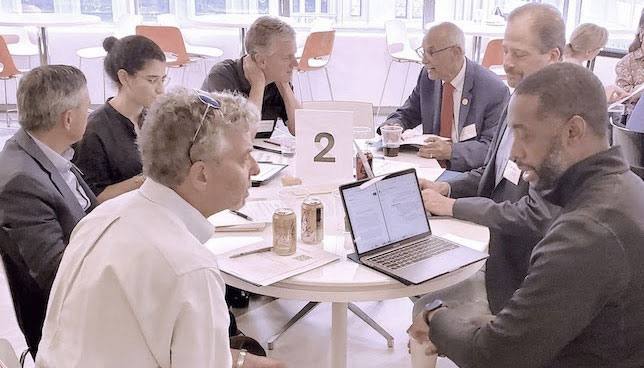 A lively discussion this past summer at the workshop "Sustaining Open Source Software in the Research Enterprise," co-hosted by Ithaka S+R and Apereo, with a grant from the NSF and support from others. (Photo by Patrick Masson. Courtesy Apereo, with permission.)
Mary Grush: How has the perception and acceptance of open source changed over time? Can you give us a brief timeline?
Patrick Masson: Sure. I generally mark the beginning of that timeline with the [recognition and] emergence of open source in higher education, which dates to around 2004. And then, if you went to EDUCAUSE in 2010 or 2012, you saw open source everywhere. If you remember, that's when OpenClass from Pearson came out. It's when Instructure announced Canvas as an open source LMS. The New York Times named 2012 "The year of the MOOC". And open education resources became a big topic. Indeed, you saw a large-scale onboarding of open source in higher ed.
My organization, Apereo, started in 2012 with the merger of Jasig and Sakai. And of course Sakai had already appeared a few years earlier, in 2004 and proceeded with universities including Carnegie Mellon and Indiana and Michigan and Stanford and UC Berkeley — all collaborating to build an open source LMS and bring together more institutional members. So all this openness was happening, and very visibly: Universities were really getting into not just open source software, but also OERs, open access, open data, and other open initiatives relevant to open source within higher education.
This all peaked around 2012 to 2014. The ed tech industry — the commercial and proprietary software vendors — saw the interest in and appeal of open source. Industries across the board were adopting open source.
Open source predominance was solidified even further in 2014 and 2015 when OSPOs — open source program offices — fueled interest across industry, from PayPal and Bose to BMW and Boeing to John Deere and Walmart and Target. All these tech companies and many more began their initial investments in OSPOs. Higher education caught up, mostly in 2021 to 2023, with numerous OSPOs on campuses — many with funding from the Sloan Foundation.
But during that same timeframe, when OSPOs were showing up in companies and on campuses, higher education became more passive users of open source: Many campus CIOs, looking to cut costs, shifted to SaaS models and remote hosting services by commercial providers. This reduced local infrastructure costs (e.g., in data centers) but also deferred software decision making to third parties.
And by then, those third-party companies were running basically everything on open source, and building everything with open source — they were more than happy to take control of open source from higher ed. So oddly, the same campuses where open source tools like Apache, GNU/Linux, and PostgreSQL were created, ended up paying third-party providers for using them! The impact was a loss of agency for higher education — until recently.
Finally, during the past 3 or 4 years, you can see that interest in technology self-determination has picked up across the academy and is being played out now on campuses — but the question is, is higher education still focusing on "it's cheaper" or moving ahead to prioritize "it's industry standard"?
That's where we stand in the rough timeline you asked for.
Is higher education still focusing on "it's cheaper" or moving ahead to prioritize "it's industry standard"?
Grush: What are the opportunities for higher education to become proactive in open source again?
Masson: I think we now have an opportunity to ask questions that will elevate discussions of open source from purely budget considerations, to meeting broader expectations and aspirations in areas like: digital sovereignty; data protection; privacy; the response to big tech's mass surveillance; open science initiatives; guarding our innovation spaces; regulatory compliance; and of course, artificial intelligence. That's the short list of motivations I can point to for where we are now — there are many more opportunities and drivers emerging from a standards perspective that will mean so much for our campuses.
Grush: How could smaller colleges and universities delve into open source?
Masson: Good question. Many of the topics I've just mentioned might suggest that you need to be a research-focused or big R1 institution to realize the value of open source. And while the breadth of use of open source may be bigger for large R1s, its value may be even greater for smaller campuses.
While the breadth of use of open source may be bigger for large R1s, its value may be even greater for smaller campuses.
Apereo has created an "OSPO as a service" to accommodate campuses that can't afford or maybe don't fully appreciate the value of an OSPO right now, but they have open source questions.
Examples of open source scenarios smaller colleges or universities might bring to Apereo's OSPO as a service include: a faculty member at a small campus, whose teaching grant requires open source software as an output of the funded work; or an IT shop at a liberal arts college that wants to share its internally developed software with others; or a community college that wants to explore open source options but doesn't understand how to assess open source development and differentiate between a mature project and something that a graduate student could write over a weekend.
Apereo's OSPO as a service can help, by hosting the same services a campus-based OSPO might provide. This extends the resources for open source development and understanding to a broader academic and institutional community.
And Apereo recently released a Higher Education Open Source Assessment Tool, HEOSAT. This new tool is freely available on the Apereo website. Anyone can use HEOSAT to assess an open source software tool to see if it's a useful match for their needs.
Apereo also offers training and help with governance, licensing, and everything that a campus might need to stand up an open source project. And then, if a project wants to find a fiscal sponsor, we're happy to help with that or help the institution manage an open source software portfolio of their own.
Apereo's diverse presentations and workshops meet institutions where they are, small or large or in between. On November 11 (2026) a "microconference" will explore "Open Source Software as a Strategic Enabler for Smaller Colleges and Universities". Registration is still available, and free.
Grush: What about open source development with AI? Is there some help for developers?
Masson: Yes. Apereo has created a new resource for Open Agentic Development.
It's an initiative to use open source development principles and practices within AI and agentic software development. By recognizing the alignment between how AI agents and vibe coding happens and how well that aligns with open source software development, we can provide useful resources to help those working on that type of development become more successful.
Grush: I've noticed a trend among open source software developers to try to recoup their investment through fundraising. What does this mean for open source?
Masson: The ethos and practice of open source that we built in the 'good old days' of early open source development created open source tools as by-products of a developer's 'real job'. Far too often, this tended to focus higher education decision makers on open source as pure cost avoidance.
As early as 2016, a grassroots, shared advocacy movement began within open source communities. It eventually came to be called "maintaining the maintainers". It's been around for at least a decade, quietly promoting the idea that those who actually use the software should, at the end of the day, be paying something back into it.
Let's say that I'm a university and I pay company X to host Sakai or Moodle or whatever it might be. Then I'm relying on that company to transfer some money back to the project. But companies don't have to do that. Some commercial companies are making potentially billions of dollars, but sadly they are not giving back to the projects.
Some commercial companies are making potentially billions of dollars, but sadly they are not giving back to the projects.
So, the immediate value of open source is often considered as a cost saver and revenue generator, but ongoing support isn't making its way back to the projects themselves — and that's a risk factor that has become a real issue in the open source community.
Grush: So are fundraising campaigns within the context of open source becoming commonplace?
Masson: Yes, these direct appeals are now common.
Open source software has to be maintained, it has to be secure, and it has to be updated. If it becomes a core infrastructure issue for you, you should be supporting it on some level. So, that's the motivation behind these direct appeals you're seeing more of.
Apereo is following the trend of direct appeals to open source consumers to pay their fair share for the quality software they enjoy and rely on. Some examples include campaigns by Sakai, Python, Moodle, Fedora, DSpace, and Drupal.
Apereo is following the trend of direct appeals to open source consumers to pay their fair share for the quality software they enjoy and rely on.
Grush: Are open source developers beginning to change their revenue models up front, for long-term accountability?
Masson: Yes, gradually. But there still seems to be a lack of appreciation and awareness by end users, including universities, on how much open source they're actually dependent on, and what a recognized obligation should be. We still have a long way to go with changing these perceptions.
There still seems to be a lack of appreciation and awareness by end users, including universities, on how much open source they're actually dependent on, and what a recognized obligation should be.
And the most trusted third-party vendors, including the providers of education technology to campuses, rely on open source. They pick open source not because it's cheaper, but because it's high quality — and more secure; more stable. So everything is built on open source. It's time to turn the discussion from "it's cheaper" to "it's industry standard".
It's time to turn the discussion from "it's cheaper" to "it's industry standard".
Grush: Will we eventually see the perception of open source, not only as a cost-saver, but as the highest quality, most secure, most equitable option in the industry?
Masson: While there's still a lack of understanding of the total value of open source, and how to update revenue models accordingly, we're heading down that road. It's an industry-wide issue, with plenty of players to take up the challenge. I think we'll get there.