Texas Wesleyan's classroom.NEXT Opens for Business
- By Dian Schaffhauser
- 09/06/11
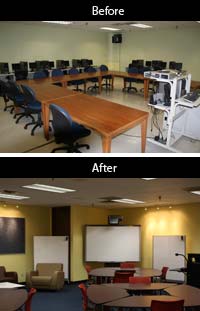
classroom.NEXT's implementation at Texas Wesleyan University. |
A design for a next-generation classroom that won an award earlier this year at Texas Wesleyan University has moved off the drawing board and into three dimensions at the Fort Worth institution. The winning proposal of classroom.NEXT, put together by Elizabeth Alexander, an associate professor of history, and five of her students, has been used to transform a traditional classroom into one that's "radically flexible," with an emphasis on four themes: flexibility, sensory stimulation, technology support, and "decenteredness."
The space features furniture and equipment that can be easily wheeled around and reconfigured to promote multiple instructional methods. Other design elements include:
- A mobile instructor lectern, which allows the instructor to connect to technology components from anywhere in the room;
- Mobile whiteboards and two large Rubber-Tak boards for collaboration;
- Lounge furniture, including an ottoman topped with a whiteboard, to create an informal learning space or a comfortable space for group collaboration and presentations; and
- Technology, including laptops and iPods.
"classroom.NEXT blurs the line between 'computer lab classroom' and 'traditional classroom' by facilitating interactions that occur in computer lab classrooms and in traditional classrooms," explained Amy Collier, director of the Center for Excellence in Teaching and Learning. The Center sponsored the competition. The room "provides the technology needed for inquiry, problem-solving, and creating electronic artifacts that you often see in computer lab classrooms, while offering flexibility and comfort beyond what traditional classrooms offer."
People have nicknamed the space, "the Wow classroom" because the most common response from students, faculty, and staff is "Wow!" Collier said. "I have heard students say, 'I want to take all of my classes in this room,' and 'After having a class in this room, I wouldn't want to go back to my other classrooms.'"
She noted that the renovation cost about $10,000 more than the cost of a lab classroom and traditional classroom combined, "thus allowing the room to serve both classroom purposes and creating an environment for a variety of teaching and learning activities."
That outlay broadcasts an important message, she added. "It's a beautiful classroom that signals to students the university's investment in their learning and the expectation of their own investment in learning. We are confident that both investments in students' learning--the university's and the students'--will yield positive benefits that stay with the students well beyond the Texas Wesleyan classroom experience."
About the Author
Dian Schaffhauser is a former senior contributing editor for 1105 Media's education publications THE Journal, Campus Technology and Spaces4Learning.