Assessing Portalness
Campuses are continuing to expand their offerings of online services. In the
past it was the core administrative systems. When most course management systems
were initially implemented, they were isolated from the traditional enterprise
administrative systems. Soon, however, it became clear that users were not well
served if they were addressing each system individually. There rose a demand to
integrate not only these offerings, but also other online services outside the
university. A portal implementation became the means to address these needs.
For many students and faculty, the portal is a critical integration component
for the course management system. In the following viewpoint we explore how to
evaluate the portal's effectiveness.
For those who have gone through the arduous task of developing and deploying
a Web portal for their college or university, as we have at the University of
Georgia, now comes the work of assessing the success of our individual-centric
gateway to Web-accessible content and services. We can certainly use access
statistics and assume that increased utilization quantifies success. But how
do we qualify a portal? If a portal is a single Web location (or address) where
an individual can access the Web-based services and information most important
to that individual, how well d'es our portal implementation succeed in offering
self-managed, personalized, and customized information environments? What are
its attributes and how well d'es our portal measure up to those attributes?
Vertical and Horizontal Attributes
The terms "Vertical Enterprise Portal" or "Horizontal Enterprise
Portal" submitted to any popular search engine will return thousands of
hits. However, a Syllabus TechTalk featuring Howard Strauss titled "What
is a Portal, Anyway?" offers an excellent explanation of these portal types
[http://www.campus-technology.com/techtalks/events/000120portal.asp].
Using Strauss' description as a base, we see that a true portal has aspects
of both portal types, and exhibits vertical and horizontal attributes.
Horizontalness most fundamentally refers to the breadth of information contained
on the portal. Horizontal portals offer visitors an aggregation of content and
services at one Web location and are available to anyone on the Internet. They
may be very general (My Yahoo!) or focus within a particular subject area (WebMD).
Because of the large volume of content and services, these sites typically offer
ways to personalize the visitor's experience. This personalization includes
preferences regarding content interests and appearance (e.g., fonts, colors,
arrangement of content), with these preferences retrieved when the visitor accesses
the portal. An actual login may not be required, since Web cookies (small bits
of information stored on the user's computer and retrieved by the Web server
each time the portal is visited) can be used to determine preferences.
A vertical portal is one characterized by depth and pertinence of content and
services, particularly as the content and services relate to the role of the
individual within a specific enterprise.
Vertical portals are typically not
available to everyone on the Internet, but only to those with an affiliation
to a particular enterprise. Within a college or university, for example, these
affiliations include student, faculty, staff, and administrator. When a student
logs into the portal, he/she should receive a different view of the academic
enterprise from a faculty member or administrator. These are custom views and
are not under the direct control of the visitor but are based on the relationship
of the visitor to the enterprise. And this verticalness can be articulated down
to the individual. When Dr. Sam Jones logs into his portal, he will see an integrated
view of his courses, his "business" e-mail, his communities of interest
(which may be assigned based on presumed interest according to departmental
affiliation), his vacation days, and his retirement benefits. At this individualized
level, multiple logins are eliminated even though the information may come from
a variety of discrete Web-enabled services.
We have concluded from these general descriptions that there is a significant
correlation between horizontalness and personalization (making the portal look
and feel a certain way based on individual preferences) and between verticalness
and customization (providing content and services based on the relationship
the individual has to the enterprise). Specific attributes associated with each
are:
|
Horizontal Attributes
(Breadth of Content and Services)
|
Vertical
(Depth of Content and Services) |
| Significant number of content/service choices |
Authorization (user ID and password) |
| Ability to arrange choices on and across pages within the portal |
Affiliation detection (part of the enterprise) |
| "Skin" choices (ability to change general appearance) |
Affiliate type detection (student, faculty, staff, alumni) |
| Font, color choices (ability to change specific appearances) |
Association (department, class, school) |
| Agile visual integration (default consistent appearance for static and
dynamic content). |
Process integration (single sign-on; data/process integration across multiple
applications and services). |
The Portal Magic Quadrant and the Ultimate Goal: A "Blended" 10
To easily and quickly assess the quality of our portal implementation, we adapted
Gartner's Magic Quadrant. Gartner uses their Magic Quadrant to rate technology
vendors and service providers with respect to their ability to execute within
the marketplace and completeness of vision. We used the same general template
to assess portalness, using verticalness/customization and horizontalness/personalization
as the metrics.
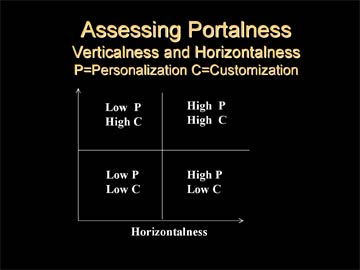
Verticalness and horizontalness work together to complete the successful portal.
A significant number of services (horizontalness)-e-mail, online registration,
online courses, online communities, and employee services-should be accessible
via a single sign-on (verticalness). Online communities and content should be
presented to an individual based on affiliation (verticalness), but he/she should
be able to remove content, subscribe/unsubscribe from communities, and arrange
content based on preference (horizontalness). Only by offering a blended, complementary,
and complete view of the enterprise can the ultimate goal be achieved-an individual-centric
gateway to Web-accessible content and services.
[Author's Note: The University of Georgia is using Novell ExteNd Director as
its portal platform. We launched our portal in February 2003. We would position
ourselves in the "High P/Low C" category, with the confidence that
the solution we have chosen can move us into the "High P/High C" category.
For more information on Novell ExteNd Director, see: http://www.novell.com/products/extend/director.
You can visit MyUGA at http://my.uga.edu.
A guest login is available.]