U.S. Department of Ed Workforce Prep Grants Go to 8 States
- By Dian Schaffhauser
- 09/28/20
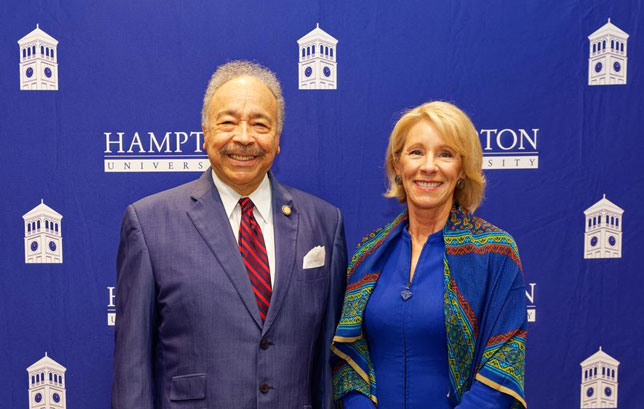
William Harvey, Hampton University's president, with U.S. Education Secretary Betsy DeVos, during the announcement of winners in the Reimagine Workforce Preparation Grant Program. Source: Hampton University
The U.S. Department of Education is funding efforts in eight states to provide students with opportunities to develop new skills in high-demand areas. The $126 million in grants awarded to winners of the Reimagine Workforce Preparation Grant Program came out of the Education Stabilization Fund portion of the CARES Act.
Unlike traditional degree and certificate programs, which are usually designed by educators, this grant program was set up to support efforts led by state workforce development boards, working with employers, industry organizations and education and training partners, to identify workplace competencies, develop training curriculum and assessments to help workers gain those competencies, and establish a credentialing system that employers could use in hiring and promotion decisions within their organizations.
Recipients included:
- Hampton University, which received $17.7 million to work with the Virginia Board of Workforce Development in establishing the Virginia Workforce Innovation and Entrepreneurship Center, a statewide small business incubator project. Operations will be based on Hampton's campus, but will serve clients from across the state who have been unemployed, displaced or have had their jobs have become obsolete by COVID-19. Secretary of Education Betsy DeVos announced the grants during a tour of the institution last week.
- The University of Hawaii, which received $13.4 million to work on delivering distance education training; create a statewide microcredentials, badging and licensing system open to all residents; expand apprenticeship programs; and develop articulated career pathways with college credit options for short-term education and apprenticeships.
Other state recipients included Alabama, Arkansas, California, Michigan, Nevada and New York. Awards ranged from a low of $13.3 million (Hawaii) to a high of $18.1 million (New York).
States with the highest coronavirus "burden" were prioritized in the evaluation process, which was handled by a panel of independent peer reviewers.
"America's workers and entrepreneurs have been among the hardest hit by the pandemic, and this administration is committed to reigniting the entrepreneurial spirit and helping Americans reenter the workforce as the economy recovers," said DeVos, in a statement. "We created this grant competition because we saw the clear need to support lifelong learners who needed a boost to get back on their feet, and I was delighted to see so many states come forward with innovative initiatives and partnerships. By breaking down barriers between education and industry and supporting local entrepreneurs and small businesses, we can help workers thrive and get America's economic engine running at full speed again."
About the Author
Dian Schaffhauser is a former senior contributing editor for 1105 Media's education publications THE Journal, Campus Technology and Spaces4Learning.