Survey Reports Many Online Learners Never Seek Help Before Dropping Out
- By Dian Schaffhauser
- 01/09/09
Among online students who dropped out of their degree or certificate programs, 40 percent failed to seek any help or resources before abandoning their programs, according to a recent EducationDynamics survey. Conducted in November 2008 among about 150 respondents who visited EducationDynamics' sites eLearners.com and EarnMyDegree.com, the survey was designed to identify students' motivations for deserting their online degree or certificate programs.
Financial challenges (41 percent) proved to be the main contributor to student attrition, followed by life events (32 percent), health issues (23 percent), lack of personal motivation (21 percent), and lack of faculty interaction (21 percent). Nearly half (47 percent) of students who dropped out did so even before completing one online course.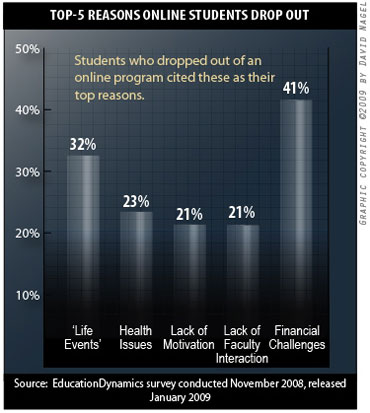
When asked to select the resources that online institutions could have provided to improve the online student experience, 53 percent craved more online student services and Web-based academic advising. Self-help, time management, and organizational advice also ranked as coveted offerings among students who dropped out (46 percent).
"These survey results confirm the fact that schools can play a more active role in retaining students by identifying their key life issues, such as important personal events and financial issues, and creating compelling interactive content that addresses them," said Peter Tomassi, senior vice president of product development for the company.
The survey also captured the school-student communication methods students prefer, and new media avenues proved to be the most popular among respondents. Ninety percent of students preferred connecting with others online through discussion forums and social networking communities. "While students tend to drop out prior to utilizing retention resources, we believe they are generally interested in such assistance so long as services are available in convenient, easily accessible formats," Tomassi said.
Of students who dropped out, the company reported, 71 percent plan to resume their online education within the next two years; 7 percent intend to enroll in a campus-based program; and 21 percent have no specific plans.
About the Author
Dian Schaffhauser is a former senior contributing editor for 1105 Media's education publications THE Journal, Campus Technology and Spaces4Learning.