Epson Boosts Brightness on LCD Classroom Projectors
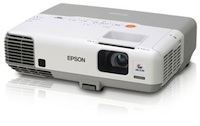

Epson's PowerLite 96W includes LAN connectivity, HDMI input, a WXGA resolution, and a brightness of 2,700 lumens for $899.

Epson this week debuted four new LCD classroom projectors in its PowerLite series. The new models, which will replace several in the PowerLite 8x series, offer higher light output than their predecessors and include new connectivity and audio features.

All of the new models--the PowerLite 92, 93, 95, and 96W--are equipped with a new 16 watt speaker come with integrated HDMI standard. The 93, 95, and 96W also include built-in LAN connectivity (via RJ-45). The PowerLite 92 and 93 are XGA-resolution projectors (1,024 x 768) with a brightness of 2,400 lumens. The PowerLite 95 is also an XGA projector but offers a brightness of 2,600 lumens. The 96W offers a WXGA resolution (1,280 x 800) and a brightness of 2,700 lumens.

The two higher-end models, the 95 and 96W, also offer the ability to project messages delivered over an IP network (such as emergency alerts) and the ability to send content of an IP network.

Features common to all of the new models include:

  • Built-in closed captioning decoder;
  • 1.2x optical zoom;
  • ±30 degree automatic vertical keystone correction plus ±30 degree horizontal keystone correction;
  • Built-in screen patterns designed as teaching aids, such as a "graph paper" pattern (with support for customized background images as well);
  • Lamp life of up to 6,000 hours in economy mode;
  • Instant on/off and direct on/off (allowing instructors to turn a projector on or off via light switch); and
  • USB control via Mac OS X or Windows systems, with a browser-based "virtual control:" that can be used in place of the standard remote control.

The PowerLite 92, 93, 95, and 96W are expected to ship in March for $649, $699, $799, and $899, respectively. Further information can be found on Epson's Brighter Futures site.

About the Author

David Nagel is the former editorial director of 1105 Media's Education Group and editor-in-chief of THE Journal, STEAM Universe, and Spaces4Learning. A 30-year publishing veteran, Nagel has led or contributed to dozens of technology, art, marketing, media, and business publications.

He can be reached at [email protected]. You can also connect with him on LinkedIn at https://www.linkedin.com/in/davidrnagel/ .


Featured

  • businessman holding tablet with holographic AI icons

    Google Moves AI Agents into the Mainstream

    At its recent I/O developer conference, Google presented artificial intelligence agents not as a distant research project, but as a product strategy spanning Search, personal assistants, productivity software, developer tools, and smart glasses.

  • Digital Screen with young woman using a virtual reality headset

    Montclair State U Partners with Dreamscape Learn on New VR Facility

    New Jersey's Montclair State University has announced the completion of a new virtual reality learning facility developed in partnership with Dreamscape Learn. The 2,450-square-foot lab space is inside the College of Communication and Media building and will serve students pursuing careers in digital media, virtual reality, and content creation.

  • abstract agentic ai data streams

    Rubrik Brings Agentic AI to Flagship Cyber Resilience Platform

    Rubrik recently introduced Rubrik AI, positioning the company's cyber resilience platform around agentic operations across data, identity, and AI infrastructure.

  • abstract glowing cube outlines

    Microsoft Positions Windows as an Operating Environment for AI Agents

    The recent Microsoft Build 2026 developer conference highlighted a significant shift in the company's Windows strategy. Rather than presenting artificial intelligence as a collection of standalone features, Microsoft is increasingly positioning Windows as a platform for AI agents.