Clarkson U Video Wall Uses LED Tiles To Broadcast School Doings
A small research university in New York is using LED tiles in a large video display that lets students view campus news, watch live television, and even play video games.
- By Dian Schaffhauser
- 05/04/11
Clarkson University, a small research university with 2,850 students in Potsdam, NY, has installed a 10' x 8' video display in its new student center using unique digital tiles that can be manipulated and expanded like mosaics. The display incorporates 80 MicroTiles from Christie Digital Systems to show information about campus events, sports, live music from the campus radio station, and four high-definition television feeds. The installation is also used by students for video games and to create interesting backdrops during live performances.
The magic behind MicroTiles is DLP or digital light processing, a technology invented at Texas Instruments that's used in rear projection television. Luminus Devices uses the TI tech in its own line of light-emitting diodes (LEDs), the PhlatLight, which is what powers the MicroTiles. According to Christie, its MicroTiles offer substantially brighter images and a much wider color palette than conventional flat panel LCD and plasma displays.
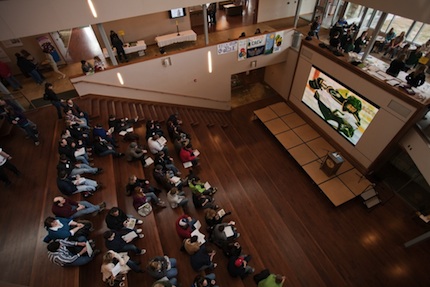
The video wall sits in the amphitheater in Clarkson University's student center. |
There's also no practical limit to the number of tiles that can be used in a display. The tiles lock together and automatically detect each otherto display images on the screen. When one needs repair, it can be slid out individually from the wall and replaced. The company estimated that a tile will offer about 7.5 years of continuous service.
The video wall at Clarkson forms the centerpiece of an amphitheater in the school's student center, which opened in September 2010. Developed by Video Visions, a company that specializes in presentation screens, the wall combines the MicroTiles, media servers, and a Crestron touch panel.
"Our school is very technology-focused, so it was important for us to have state-of-the-art multimedia," said Clarkson CIO Kevin Lynch. "We're especially pleased that our design students can use the wall as a canvas for their own work. It gives them a learning experience on the latest in digital display technology. It's also easy enough to program, so that anyone with good laptop skills can do it."
Lynch said the cost competitiveness of the MicroTiles installation surprised him. "Upon factoring in the lower maintenance costs, greater longevity, and the fact that you can replace individual modules without scrapping the whole system, the total cost of ownership made MicroTiles the best option over competing proposals. Christie MicroTiles are also much more environmentally-friendly than most of the alternatives."
One challenge surfaced during the six-day installation, said Ted Manahan, director of sales and engineering at Video Visions. "The installation backs onto a solid wall, so there is no rear access. This isn't a maintenance problem, since MicroTiles can be maintained from the front, but it did mean the wiring and signals had to be carefully planned and tested for each tile as we went along, since there is no second chance."
When the video wall was completed, it was used to display a multimedia video and live stage performance about the founding years of the university. Since then, among the regular daily feeds, Clarkson has also showcased student artwork and Jeopardy's competition featuring IBM's "Watson."
About the Author
Dian Schaffhauser is a former senior contributing editor for 1105 Media's education publications THE Journal, Campus Technology and Spaces4Learning.