NEC Launches Sub-$500 Mobile Projector
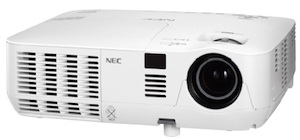
The sub-$600 NEC V260X includes an HDMI input and support for networking and control via Ethernet.

NEC this week debuted two new entry-level mobile classroom projectors, both coming in at less than $600.

The new NEC V260X is an XGA-resolution DLP projector (1,024 x 768) that offers a brightness of 2,600 lumens and a contrast ratio of 2,000:1. The other new model, the V260, offers the same brightness and contrast ratio as the V260X but tops out at a lower native resolution: 800 x 600 (SVGA).

The V260X includes 100 Mbps wired LAN connectivity (via RJ-45) and HDMI support. It also incorporates Crestron Roomview for control and power management.

Both models also offer:

  • DDC/CI support for controlling the projector from a computer via the monitor cable;
  • Support for closed captioning;
  • Carbon savings meter;
  • Integrated 7 watt speaker;
  • Color wall correction presets;
  • Automatic shutoff when an input signal is not detected; and
  • Lamp life up to 5,000 hours.

AV inputs on the V260X include HDMI, dual RGB/component (mini D-sub 15-pin), S-video, composite video, stereo minijack, and stereo RCA audio. AV outputs include RGB (mini D-sub 15-pin) and stereo minijack. Networking and control ports include LAN (RJ-45) and RS-232.

AV inputs on the V260 include dual RGB/component (mini D-sub 15-pin), S-video, composite video, and stereo minijack. It also includes RGB out (mini D-sub 15-pin) and RS-232 control support.

Both projectors are expected to ship in June. The SVGA NEC V260 will sell for $439; the XGA V260X will run $548. Further details can be found on NEC's education portal.

About the Author

David Nagel is the former editorial director of 1105 Media's Education Group and editor-in-chief of THE Journal, STEAM Universe, and Spaces4Learning. A 30-year publishing veteran, Nagel has led or contributed to dozens of technology, art, marketing, media, and business publications.

He can be reached at [email protected]. You can also connect with him on LinkedIn at https://www.linkedin.com/in/davidrnagel/ .


Featured

  • closeup of hands using smart phone

    Learning Continuity Built into the LMS Withstands Cloud or Cybersecurity Interruptions

    When your institution's administrative or instructional capabilities face disruption from natural, technical, or malicious events, what measures does your LMS offer to provide a "business as usual" operating and learning environment? Instructure's Ryan Lufkin comments on the LMS and learning continuity.

  • digital brain with network connections

    Microsoft Moving to Internally Developed AI Models in Office Apps

    Microsoft is reportedly using its own in-house artificial intelligence models to handle some workloads in Excel and Outlook, offering new evidence that the company is moving its AI strategy beyond model development and into large-scale cost reduction.

  • businessman holding tablet with holographic AI icons

    Google Moves AI Agents into the Mainstream

    At its recent I/O developer conference, Google presented artificial intelligence agents not as a distant research project, but as a product strategy spanning Search, personal assistants, productivity software, developer tools, and smart glasses.

  • artificial intelligence on laptop

    OpenAI to Combine AI Products into Desktop 'Superapp'

    OpenAI is reportedly developing a desktop application that would combine several of its emerging AI products into a single platform, according to reports, marking the latest step in the company's effort to transform ChatGPT from a standalone chatbot into a broader productivity and automation environment.