UC San Diego Gets Big Picture with 'OptIPortable' Video Walls
- By Dian Schaffhauser
- 09/22/11
The University of California, San Diego (UCSD) has decided that more and bigger is better, especially for immersive experiences. The university is building out its collection of virtual rooms that use multiple large-screens for visualization.
In August 2011 UCSD's California Institute for Telecommunications and Information Technology (Calit2) purchased 38 of NEC's 55-inch X551UN displays. These have been installed in Vroom, a virtual room made up of three large video walls.
"The new Vroom video wall has enabled our researchers and their students to take their collaboration capability to a new level and has challenged them to explore new areas of information technology with a completely immersive mixed media environment," said Thomas DeFanti, director of visualization for Calit2.
Calit2, which brings together technology research with a focus on applications, refers to these wall-sized visualization facilities or clusters as "OptIPortables." First installed in March 2010 at UCSD using 32 NEC X462UN displays and then elsewhere at its partner institutions around the world, the Institute uses the video walls to allow simultaneous video conferencing and visualization of large-sized data sets.
Calit2's research teams, which are global, use the OptIPortables in multidisciplinary studies and online collaboration. Users run software off of laptops, tablets, and smartphones and do freehand writing across displays through a tablet program. As more display real estate is needed, the users can wheel together additional clusters of displays to expand the view and attain resolutions up to a 100 times that of a standard PC.
Portability is an essential aspect of the OptIPortables, which have traditionally consisted of four large displays on wheels and a separate display for video conferencing. During the August Siggraph conference, in partnership with Saudi Arabia's King Abdullah University of Science and Technology, the university built a 20-foot by 20-foot booth on wheels consisting entirely of 32 46-inch displays facing outward. The screens were linked together as a single giant canvas showing images that could be manipulated by sliding them around on the displays. Different walls were dedicated to showing different research projects. "We wanted to prove we could build something that was elaborate and different, but also very transportable and configurable--sort of an Erector Set for screens," DeFanti explained.
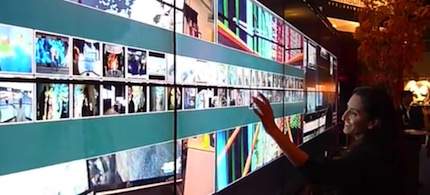
UCSD partnered with King Abdullah University of Science and Technology to deliver a 20' x 20' interactive video wall at Siggraph 2011. |
To assemble the booth, Calit2 used a motorized system with a linear actuator to raise and unfold each array of screens. Those came out of custom road cases on wheels that are narrow enough to fit through a typical office door. Set-up took about four hours. Disassembly took 90 minutes.
Additional projects by Calit2 have included a video wall in the lobby of UCSD's Jacobs School of Engineering and another in China. "The response we have received is incredible," DeFanti said. "We are placing NEC displays throughout Calit2 because of their reliability, aesthetics for viewing, and broad connectivity options. The ultra-high resolution imagery and interactive experience that the wall provides is outstanding."
According to DeFanti, NEC displays have been used because "they consistently offered the narrowest bezels we could purchase at the time, a critical issue for viewing super-high-resolution imagery." Also, he added, NEC has displays in the sizes the Institute needs. More recently, the display shopping list has added the requirements of LED backlighting and 2D and 3D collaboration capabilities.
"We'd like to see improved energy conservation and power management in display technology, 3D capability and a built-in multi-touch input capability," said DeFanti. "Our faculty, researchers, and students are consistently getting deeper into collaboration using display technology to overcome distance barriers."
About the Author
Dian Schaffhauser is a former senior contributing editor for 1105 Media's education publications THE Journal, Campus Technology and Spaces4Learning.