4G iPad Debuts with Faster Processor, Improved Display
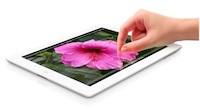
The Apple 4G iPad retains the familiar look and feel of previous-generation iPads. |
Apple formally took the wraps off the new iPad Wednesday morning. The third generation of Apple's popular tablet device incorporates a speedier A5X processor, 4G LTE support, and a higher-resolution Retina display.
Among the iPad's new features are a speedier A5X processor, a dual-core system on a chip that offers a quad-core GPU. The previous-generation iPad 2, which will continue to be sold alongside the "new" model, is built around a dual-core A5 chip operating at 1 GHz.
The 4G iPad also sports a significantly improved display. The 4G iPad's Retina display, like that of the iPhone 4S, offers a pixel density of 264 PPI, with a total resolution of 2,048 x 1,526--four times the total pixels of the iPad 2's XGA display, which had a pixel density of 132 PPI.
Other hardware features in the 4G iPad include:
- New support for 4G LTE, with continued support for 3G and Edge;
- 10-hour battery life (same as the previous model) or nine hours when running 4G;
- Hotspot support (where supported by the carrier);
- A back camera capable of capturing 5 megapixel still images and 1080p HD video at 30 FPS;
- A front-facing, VGA-resolution camera;
- Support for Bluetooth 4.0; and
- Support for 802.11a/b/g/n WiFi.
Also at the event today, Apple made some software announcements, including the launch of iPhoto for iPad ($4.99), incorporating several features not currently available in the desktop version, such as editing brushes; iOS 5.1; an upgraded version of iWork an iLife apps for iPad; new features in iCloud; and some upgrades to iTunes.
Apple also launched a new version of the Apple TV, an update to the company's smart set-top box that now includes 1080p support and an updated UI. It will be available March 16 for $99.
The 4G iPad is expected to ship March 16 for $499 for the base 16 GB WiFi model. The 32 GB and 64 GB WiFi models will sell for $599 and $699, respectively. The base 4G model will start at $629 for the 16 GB version. The 32 GB and 64 GB 4G models will sell for $729 and $829, respectively. Preorders are available now. The iPad 2 will continue to be sold and will start at $399 for the WiFi version, $529 for the 3G version.
Additional details about the third-generation iPad can be found on Apple's education portal. Details about educational pricing can be found at the Apple Store for Education.