Apple Launches 7.9-Inch iPad mini, 4th-Gen iPad
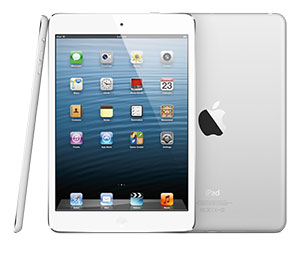
The new iPad mini offers dual-band 802.11n wireless networking. |
Apple today unveiled the iPad mini, a 7.9-inch tablet built around a dual-core A5 chip and offering dual-band 802.11n wireless networking. The company also launched the fourth-generation iPad, as well as new models in its MacBook and iMac product lines.
The new iPad mini offers a 7.9-inch (diagonal) multi-touch LED screen, with a resolution identical to the original iPad and iPad 2 (1,024 x 768), providing support for all current iPad apps. It measures 7.2 mm thick and weighs in at 0.68 pounds. According to Apple, the iPad mini's dual-band 802.11n wireless networking capabilities provide up to 150 Mbps data rates, twice that of previous iPads.
Accessibility features include VoiceOver screen reader; support for closed-captioned content through Guided Access; AssistiveTouch; full-screen zoom; large text capabilities; and the ability to invert colors.
Other features include:
- 5 megapixel (rear) iSight camera and front-facing 1.2 megapixel camera;
- Bluetooth 4.0;
- Support for 1080p HD video recording;
- Support for LTE and DC-HSDPA in cell-enabled models; and
- Up to 10 hours of battery life.
The WiFi-only iPad mini is expected to be available Nov. 2 in black/slate and white/silver for $329 for the 16 GB model, $429 for the 32 GB model, and $529 for the 64 GB model. The cellular version is expected to ship two weeks later and will retail n the same three configurations for $459, $559, and $659, respectively. Cellular plans will be available through Sprint, AT&T, and Verizon. Additional details can be found on Apple's site.
Apple also introduced the new fourth-generation iPad, built around Apple's new A6X chip, which, according to the company, "delivers up to twice the CPU performance and up to twice the graphics performance of the A5X chip, all while delivering an incredible 10 hours of battery life in the same thin and light iPad design."
The fourth-generation iPad includes a 9.7-inch Retina display and includes the new 1.2 megapixel front-facing FaceTime camera, dual-band 802.11n wireless networking, and additional LTE support.
The WiFi-only fourth-generation iPad is also expected to be available Nov. 2. It will retail for $499 for the 16 GB model, $599 for the 32 GB model, and $699 for the 64 GB model. The cellular model will be available two weeks later in the same configurations, retailing for $629, $729, and $829, respectively.
More details about the new iPads are available on Apple's site.