The Naked Truth About Full-Frontal Presentations
As part of Common Core's shift of focus from teaching to learning, students are delivering more presentations (while teachers and peers sit-and-get). Not surprisingly, the same boring presentation techniques don't work any better for students than they did for teachers.
Both research and personal experience concur, for example, that recall goes down when presenters read bullet points from their slides. And that talking head with so much to share? A total waste of time after 10 minutes! As cognitive psychologist John Medina (Brain Rules) has documented, even if the audience struggles to pay attention, by the 10-minute point, retention inevitably approaches zero.
So, what does make a presentation both engaging and memorable? The naked truth? Of the literally hundreds of strategies, step-by-step examples, activities and resources in my latest book, They Snooze, You Lose: The Educator's Guide to Successful Presentations (Jossey-Bass/Wiley), here are a few of the most fun and easy-to-replicate.
Blue Eggs
Apply the powerful research of Richard E. Mayer (Multimedia Learning), whose 17 studies all document one technique that results in a 42 percent increase in recall and retention and an 89 percent boost to transfer of knowledge and application of skills:
- Delete all the text from your slides.
- Replace those words and bullets with full-screen, full-color, photographic images.
- Narrate over the slides.
First the image (via the visual-input channel), then the text (via the audio-input channel). Like the cowboy and the horse, each has its non-interchangeable place in the collaboration for optimal performance.
To illustrate this point, enjoy the exemplary three-slide Bird Report of full-bleed images and the passionate second-grader's voice-over narration designed to go straight to your long-term memory:
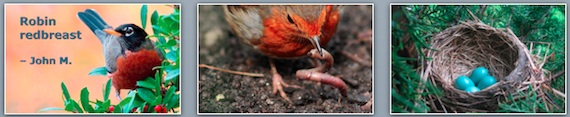
|
| Hi! My name is John, and my bird is the robin redbreast! See my bird live in the bushes where he eats tasty red berries. But his favorite food is ... |
Worms! Yummy!
And the special thing about my bird — that no other bird has — is that my bird lays ...
|
blue eggs! |
Do you think Johnny (or his classmates) will ever forget those blue eggs?
Which presentations on your plate you could deliver in this three-slide plus voice-over narration manner?
Make Sense
Read Chapter 11 of They Snooze, You Lose, "Engaging Senses," and also check out Lawrence Baines' ASCD book, A Teacher's Guide to Multisensory Learning. Discover the research on motivating students and helping them retain more knowledge longer by using sight, sound, smell, taste, touch and movement in the classroom. Do you think Johnny could make his presentation even more engaging and memorable by asking the other students to pull the robin egg blue crayon out of their Crayola coloring boxes, twirl it around in their fingers, read the label, and then draw a picture of one of those eggs? In his enthusiasm, might Johnny be tempted to add: "From now on, every time you use this crayon, remember that you have my bird to thank?" (After doing the research and developing their presentations, the kids do develop an almost parental pride in their adopted bird!)
The next most powerful strategy (after full-screen images with voice-over narration) comes to us from Robert Marzano (Classroom Instruction That Works). According to Marzano's extensive research, of all the teaching strategies, the most effective is "identifying similarities and differences."
Is this also true for presentations?
Let's consider the example of Martin Luther King's 1993 "I Have a Dream" speech. In the sixteen-minute speech, the audience applauds twenty-seven times. Each burst of applause follows a comparison between what is and and what could be. As presentations guru Nancy Duarte writes (Resonate: Present Visual Stories That Transform Audiences): "King masterfully uses descriptive language to create images in the mind. For example, he states: 'Now is the time to rise from the dark and desolate valley of segregation to the sunlit path of racial justice.'" You can feel the warmth of sunlight on your cheek, just as you can lift your eyes to see the "red hills of Georgia...[where] the sons of former slaves and the sons of former slave owners [are sitting] down together at the table of brotherhood."
While King creates comparisons with verbal images, in our presentations we can set the stage with comparisons of photographic images. For example, if our topic were "seasons," or "leaves and flowers," we might juxtapose the following images:
Check out my little video on YouTube on this activity:
Feel free to show this royalty-free video to make the point about comparisons to audiences in your own classrooms or other presentations! (You can find more of Lynell Burmark on YouTube.com. — D.N.)
What if one of the goals of your presentations were to raise test scores? Obviously, the strategies already suggested would help with recall and retention, which are at the heart of standardized testing (if one may use the terms "heart" and "testing" oxymoronically in the same sentence). In addition, thanks to research conducted by John Medina (Brain Rules) and other cognitive psychologists, we know the benefits of eating chocolate during the studying (i.e., cramming) phase and again during the actual test. No kidding: Eating chocolate can boost scores 15 percent to 50 percent. Whenever possible, offer healthy dark chocolate before making a point that you especially want the audience to remember!
In my live, always chocolate-enhanced presentations, I share many more strategies for teachers (and their students!) to apply. To end this short article, let me point you to another YouTube video: "Lesson Plan Tip: Tell Stories!"
The naked truth? Keynote speakers, mega-church preachers, beloved aunts, uncles, grandmas and grandpas all have one thing in common: They tell mesmerizing stories! The latest research — read Chapter 10 of They Snooze, You Lose, "Telling Stories" — substantiates that the rhythms of listeners' hearts actually sync up to the heart of the storyteller. Stories are not the decorative frou-frou and nutrient-void frosting on the cake. They are the cake itself. And not just any cake, but a magical cake capable of transforming everyone who partakes of its substance.
Bottom line? No matter how many tips and strategies you employ, no matter how many whiz-bang, high-tech gadgets you deploy, the ultimate value of your presentation is not how many people you entertained, but how many lives were transformed in the process — how many people will be doing something differently and doing different things because of what they learned and what ideas you sparked during the precious time you had together.