Education Boosting Chromebook Shipments to 5.2 Million Units This Year
Chromebook sales will reach 5.2 million shipments this year, largely on the strength of the education market, according to a new report from market research firm Gartner. That's a 79 percent increase over 2013 sales, and the company predicts the devices will continue to experience impressive through 2017, when it forecasts 14.4 million shipments.
Education is far and away the driving force behind Chromebook sales, accounting for 85 percent of shipments in 2013, according to Gartner, and the United States, where 2.9 million of the devices were sold last year, makes up the bulk of the global market.
"While Chromebooks are primarily used by the education sector," according to a news release, "they will also have a place in businesses for specific workers, such as staff in banking, financial services, estate agents and hotel receptionists."
"So far, businesses have looked at Chromebooks, but not bought many," said Isabelle Durand, principal analyst at Gartner, in a prepared statement. "By adopting Chromebooks and cloud computing, businesses can benefit; they can shift their focus from managing devices to managing something much more important — their data."
The devices, which encourage sharing and collaboration according to Gartner, may become more appealing as users move to the cloud and collaborative working practices become more common.
Samsung and Acer, the two companies that were the first to enter the market in 2011, continued to dominate in 2013. Samsung captured 64.9 percent of the market with 1.7 million units shipped. "It was especially dominant in the education market, having the most popular devices in primary and secondary schools," according to information released by Gartner.
| |
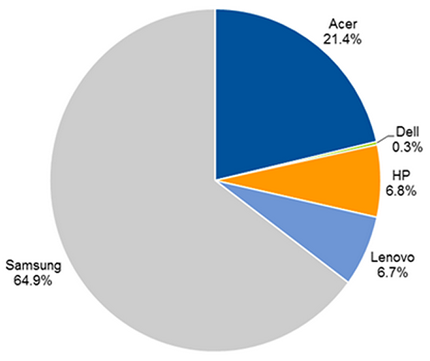
Samsung led the Chromebook market with a 64 percent share. |
|
Acer took 21.4 percent of the market by concentrating on producing less expensive devices for price-sensitive consumers.
HP, selling the only Chromebook with a 14-inch screen, held a 6.8 percent market share for third place. With a "large installed customer base in the business and education markets," the company should have an advantage in the market in the near future, according to Gartner.
Lenovo was barely edged out of the top three, with a 6.7 percent market share. The company sells comparatively rugged Chromebooks, making them appealing to schools.
Dell rounded out the top five Chromebook vendors in 2013, with a .3 percent market share.
"Chromebooks will remain a niche market during the next five years," according to a news release. "To reach a wider audience, vendors need to offer better features that address cloud-based usage patterns: faster connectivity, faster memory access, faster and larger solid-state drives and strong user support in the education, business and consumer segments."
"Making a competitive Chromebook is not just a matter of hardware and price; what is most important is to show how the device's cloud-based architecture provides genuine advantages to users," added Durand.
About the Author
Joshua Bolkan is contributing editor for Campus Technology, THE Journal and STEAM Universe. He can be reached at [email protected].