Stanford Researcher Designs 'Ant-Sized' Wireless Controller for Internet of Things
- By Dian Schaffhauser
- 09/11/14
Research led by an engineer at Stanford University has designed a radio chip so tiny, an American penny dwarfs it, and so efficient, it can draw all the energy it needs to function from the same electromagnetic waves that carry signals to its built-in receiving antenna. The purpose of the radio is to compute, execute and relay commands as part of small gadgets, such as sensors, that are forming the "Internet of Things."
"The next exponential growth in connectivity will be connecting objects together and giving us remote control through the Web," said Amin Arbabian, an assistant professor of electrical engineering who has been working on the project since 2011.
With a goal of squeezing the functionality of a typical Bluetooth device into an ant-sized form, the research has required Arbabian and his team to tackle miniaturization in all areas. For example, the antenna needed to be a tenth of the size of a typical Wi-Fi antenna and operate at 24 billion cycles per second.
| |
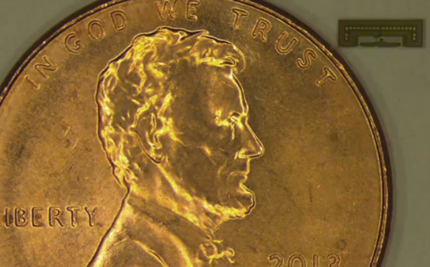
The radio chip designed at Stanford University is so small it's dwarfed by a penny. |
|
The emphasis on working in miniature would have the benefit of reducing power consumption, Arbabian explained, since a single chip pulls so much less power than the standard radio. In fact, he claimed, if the chip did require a battery — which it doesn't — a single AAA would have enough power stored in it to run the chip for more than a century.
The final design, demonstrated at the 2014 IEEE Symposium on VLSI Circuits in Hawaii, consists of a receiving antenna that yanks energy from incoming electromagnetic waves; a transmitting antenna to broadcast replies and relay signals over short distances; and a central processor for handing instructions. It can be manufactured, he said, for "pennies."
A French semiconductor manufacturer fabricated 100 radios-on-a-chip as prototypes to prove that they work as advertised. Their size is 3.7 mm x 1.2 mm including antennas and with no additional components required; communication has a range of about 50 cm.
Now the researcher says he envisions whole networks of such chips deployed every yard or so throughout a building to provide connectivity and controls between the Internet and "smart" devices, for sensor monitoring, RFID tagging or inventory tracking.
"How do you put a bi-directional wireless control system on every lightbulb?" Arbabian asked. "By putting all the essential elements of a radio on a single chip that costs pennies to make."
About the Author
Dian Schaffhauser is a former senior contributing editor for 1105 Media's education publications THE Journal, Campus Technology and Spaces4Learning.