South Orange County Community College: Scheduling for Student Success
A Q&A with Bob Bramucci and Jim Gaston
On Friday, July 15, South Orange County Community College District held a kickoff meeting for its latest development project, SmartSchedule. CT asked SOCCCD technology leaders Robert S. Bramucci, Vice Chancellor of Technology and Learning Services and Jim Gaston, Director, IT-Academic Systems why the class schedule is an important area for development and how it fits into their larger technology strategy for student services.
Mary Grush: What is SmartSchedule? How does it fit in with other SOCCCD student services development projects you've done over the years?
Jim Gaston: SmartSchedule is the class schedule for our two colleges, Saddleback College in Mission Viejo and Irvine Valley College in Irvine, located in southern California. We originally put our class schedules online in 1995. Back then, they were just static HTML pages generated in a batch job each night. We upgraded to the first version of SmartSchedule in 2002, adding information from the course catalog, faculty profiles, real-time enrollment data, section-specific deadline dates, and campus maps highlighting the location of each class. A couple of years later we added a class shopping cart that is fully integrated with the registration system in our home-grown student system.
We are now in the process of designing and building SmartSchedule 2.0, the next step in the creation of a class schedule that is truly student-centered. Since we built the original SmartSchedule we have also built an academic planning tool (MAP — My Academic Plan), a student success recommendation engine (Sherpa), a portal that includes a student success dashboard (MySite), and a predictive analytics model that can predict the letter grade for every student in every course in our catalog. The intent of SmartSchedule 2.0 is to bring all of this information into one place and present it to students in an intuitive and understandable way.
Grush: Why are you focusing on developing technology based on the class schedule? What does this do to enhance student services? Does it integrate with Sherpa, your recommendation engine?
Gaston: The class schedule is a neglected area in higher education technology. That's a shame because it is the exact place where students are making important decisions that will impact their future. Academic planning is the theoretical path, but the class schedule is the place students sift through what is actually offered and select desired classes. Too often, we build or acquire systems in isolation and then integrate them after the fact. For example, students use an academic planning tool to select a set of courses to achieve their goal, but when they browse the class schedule they have to sift through an enormous amount of data that is irrelevant to them. Why? If the student has told us that he/she has the goal of transferring to a university with a specific major, shouldn't the classes that help meet that goal have a higher profile than those that don't? Of course, we don't want to lock students into a rigid path — we make sure they will always have the ability to easily switch views and browse the entire range of offerings. As a community college we want to encourage academic exploration, and yes, via Sherpa we can recommend courses that students might otherwise overlook.
Bob Bramucci: We want to "digitalize" the paper class schedule. When you take a paper class schedule and scan it, the result is now digital but it still acts pretty much like the paper schedule. In doing so, you're missing chances at "digitalization"— i.e., re-envisioning the service as digital from the ground up. For example, when I first moved to Southern California, I depended on the "Thomas Guides" books of paper maps. Converting Guide pages to digital photos is digitization, but adding "you are here" way-finding, turn-by-turn directions, and crowdsourced traffic is digitalization. Academia has had paper schedules for about 500 years, so this is a big opportunity!
Grush: Are you developing this all in house? Who is building it?
Gaston: We have a great team of developers that includes staff and consultants who are not only wickedly smart but also passionate about student success. They have produced systems in the past that have won state and national recognition (including two awards from Campus Technology magazine) and they are excited to take on this new challenge. Last year we did a series of brainstorming sessions with college faculty and staff and compiled a list of desired features from those discussions. We also reviewed the online schedules of every community college in our state and many major universities to see what other institutions were doing. Most importantly however is that we get students deeply involved in our development projects. Every year we hire a group of students to be on our design team and they are involved in every step of the process. They are in the room when we are kicking around ideas on a whiteboard. They are the first to review wireframes and mockups and they get to kick the tires on a series of prototypes. They work with us to organize and run focus groups with students selected at random in the quad at both of our colleges. We buy a stack of pizzas and offer students walking by our booth a free slice if they will take a few minutes and give us feedback on what we're building. Finally, when we are ready to launch, the student design team creates help videos that explain to all of our students how to use the system our design team helped us build. Our student design team is a key component to our success. [Photo, below, courtesy SOCCCD]
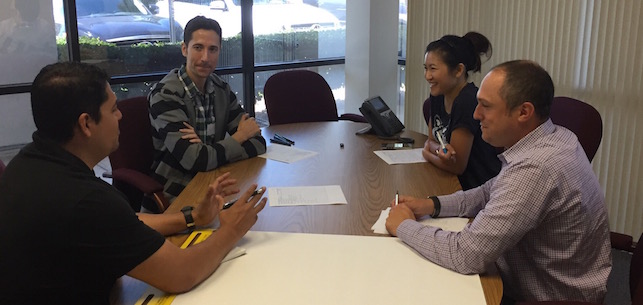
Bramucci: And it's not just what we build, or who the developers are — it's how we build it. We've used "Agile" software development methodologies for a decade, whereby diverse teams of developers, students, faculty, and staff build working modules of software in a series of short "Sprints." This method is not only inclusive but very flexible.
Grush: How would you state, very concisely, your major goals for this new development and for the investments you've already made in development around student services? What is most important to you now?
Gaston: We want to improve the success of our students by transforming the class schedule from a static repository of data into a guided pathway that helps students achieve their goals.
Bramucci: My goal is that we can fundamentally re-envision academic administrative processes to match the degree of service and personalization offered by leading digital companies.
Grush: Then what's next, broadly, for development at SOCCCD?
Gaston: Our next big project is to build on the success of Sherpa and give it a more holistic capability. Sherpa currently sends out nudges in the form of e-mails, text messages, portal alerts, course recommendations, and tasks in students' personal to-do lists. However, each nudge is in isolation and we want to improve that by providing a more cohesive and comprehensive set of steps students should take to succeed. We're currently lining up funding and hope to work on this next project as soon as we are done with SmartSchedule 2.0. We are also exploring ways we might share the systems we have built at SOCCCD with other institutions. We're excited by the idea that our work might not only help our 40,000-plus students, but students all across the state or country. There are a lot of hurdles to making that happen, of course, but we are actively exploring several options.
Bramucci: We know that by sharing and modeling more successful strategies for studying and navigating common academic and administrative tasks, others can help students improve their academic performance. What's less certain is the extent to which these behaviors can be conducted or approximated by digital agents. Another upcoming system we are working on, My Online Mentor or MOM, aims to be a collection of digital agents that together provide communications that mimic those of a caring human invested in the student's academic career — ultimately leading to higher levels of student success.