Tuition Cuts Less Effective than Increased College Spending for Retention
- By Dian Schaffhauser
- 10/26/17

A research project has concluded that tuition changes have only "modest effects" on enrollment and degree completion. A recent working paper from the National Bureau of Economic Research (NBER) found that reducing the price of higher education through tuition cuts has no discernable effect on enrollment, while a 10 percent increase in institutional spending increases enrollment by 3 percent. How could this be? Because of how the schools will probably spend that extra money.
The analysis was motivated by a specific question: If an institution receives an "unexpected" increase in state appropriations of $1,000 per student, would it be more effective in terms of student enrollment and degree completion to pass the bonus onto students in the form of tuition cuts or scholarships or to allocate the money to "smaller classes, fancier athletic facilities or other educational inputs or amenities"?
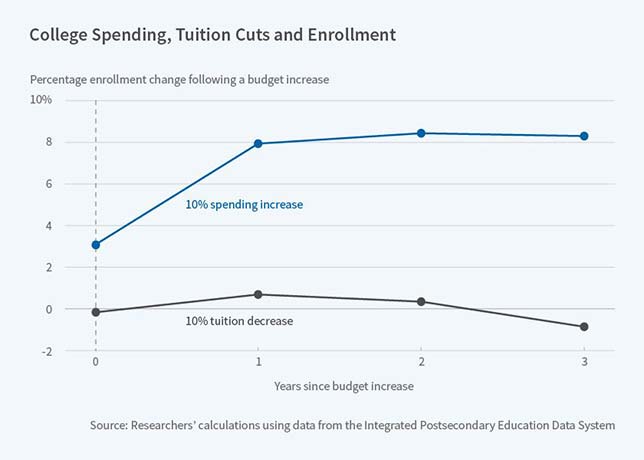
As a summary of the research noted, "in recent years, informal capacity constraints have been reported in many public institutions." These include "reduced course offerings, long waitlists, little or no student guidance and larger class sizes" all of which make it harder to finish a degree. The analysis found that schools spend about 40 cents of every additional dollar of funding on instructional spending and academic support and argued that this increased spending may enable schools to lift their constraints.
They emphasized that the results are "mostly driven by variations in tuition and spending at non-selective public institutions"; these are the schools where per-capita spending is already fairly low and student amenities are limited.
Therefore, they suggested, government programs intended to reduce college costs won't increase degree attainment if cost reduction is achieved by reducing per-student spending. "Contrary to the narrative of administrative bloat, spending cuts affect core instruction and academic support, generating large downstream impacts on educational attainment," the report stated.
Using data from 1990 through 2013 from two sources — the U.S. Department of Education Integrated Postsecondary Education Data System and a compilation of data on state tuition caps and freezes imposed by state lawmakers — the researchers concluded that direct financial subsidies for two- and four-year institutions might be more effective than tuition reductions if the goal is to increase degree completion. The researchers found that increased institutional spending led to higher persistence in enrollment of students and to greater degree completion.
A non-technical summary of the research is available on the NBER website, as is access to the full working paper, available in digital form for $5.
About the Author
Dian Schaffhauser is a former senior contributing editor for 1105 Media's education publications THE Journal, Campus Technology and Spaces4Learning.