HP Debuts 'Engineering-Grade' Full-Color 3D Printers
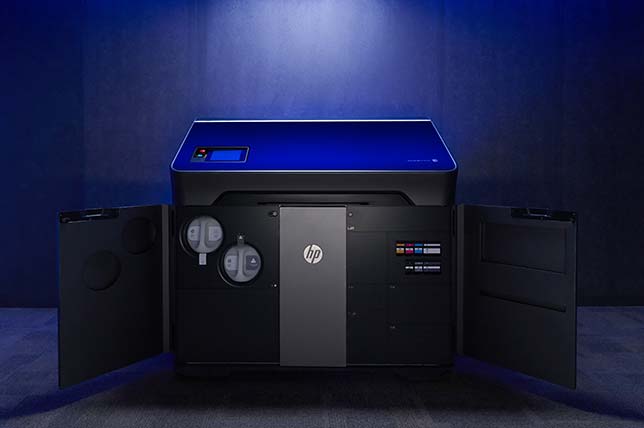
HP's new Jet Fusion 300/500 3D printing solution for functional prototyping and short run production.

HP's new Jet Fusion 300/500 3D printing solution for functional prototyping and short run production.

HP took the wraps off a new series of 3D printers capable of producing "engineering-grade, functional" parts in full color and black/white. The new Jet Fusion 300- and 500-series printers, targeted toward universities and research organizations, include four individual models and start in the $50,000s, depending on configuration.

The 300-series includes the Jet Fusion 340, a model capable of producing black or white parts, and the Jet Fusion 380, which is capable of producing parts in full color.

The 500 series is designed for producing larger parts than the 300 series (build sizes up to 7.5" x 13.1" x 9.8" for the 500 series compared with up to 7.5" x 10" x 9.8" for the 300 series). It also includes a black/white (Jet Fusion 540) and full color (Jet Fusion 580). All models offer a layer thickness as small as 0.08mm.
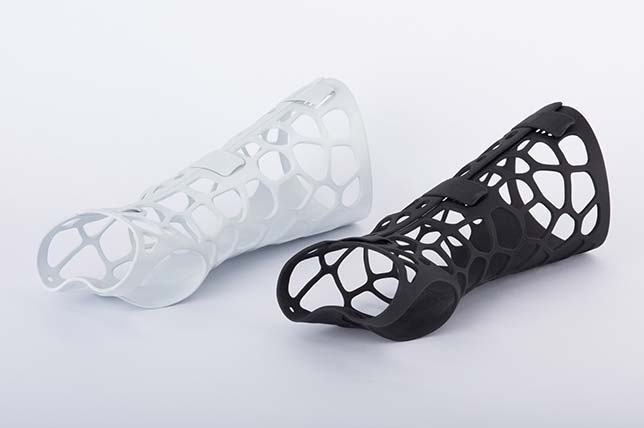
HP's new Jet Fusion 300/500 3D printers produce engineering-grade, functional parts in full color, black or white.

HP's new Jet Fusion 300/500 3D printers produce engineering-grade, functional parts in full color, black or white.

According to HP, "HP's unique ability to control part properties at the individual voxel level enables the design and production of previously unconceivable parts and is now available, for the first time, in full color. Whether in healthcare, automotive, consumer goods, or other industries; or for entrepreneurs, designers, or university researchers with the next great idea; the potential of new 3D printing applications is enormous. HP is already engaging in the codevelopment of new color applications with universities and businesses around the world including Phoenix Children's Hospital, Yazaki Corp. and Youngstown State University, amongst others."

HP also introduced a new material for the printers, HP PA Color Boost (CB) 12, which the company said is similar to the HP PA 12 used in its Jet Fusion 3200/4200/4210 industrial solutions.

Further details about the new solutions can be found on HP's site.

About the Author

David Nagel is the former editorial director of 1105 Media's Education Group and editor-in-chief of THE Journal, STEAM Universe, and Spaces4Learning. A 30-year publishing veteran, Nagel has led or contributed to dozens of technology, art, marketing, media, and business publications.

He can be reached at [email protected]. You can also connect with him on LinkedIn at https://www.linkedin.com/in/davidrnagel/ .


Featured

  • artificial intelligence on laptop

    OpenAI to Combine AI Products into Desktop 'Superapp'

    OpenAI is reportedly developing a desktop application that would combine several of its emerging AI products into a single platform, according to reports, marking the latest step in the company's effort to transform ChatGPT from a standalone chatbot into a broader productivity and automation environment.

  • woman surrounded by virtual hologram icons

    Beyond AI Adoption: Designing Learning for an Age of Abundant Intelligence

    Higher education was designed for a world in which access to knowledge, expertise, feedback, mentorship, and authentic learning experiences were inherently scarce. By making many forms of intelligence increasingly abundant, AI is inherently redefining the existing paradigm.

  • digital brain with network connections

    Microsoft Moving to Internally Developed AI Models in Office Apps

    Microsoft is reportedly using its own in-house artificial intelligence models to handle some workloads in Excel and Outlook, offering new evidence that the company is moving its AI strategy beyond model development and into large-scale cost reduction.

  • Profile silhouette of a person thoughtfully touching their chin, overlaid with transparent data visualizations and digital interface elements suggesting artificial intelligence and analytics.

    The Institutional Knowledge Shift Is Reshaping Higher Ed IT

    Higher education IT leaders are navigating a quiet but consequential transition: Experienced team members are retiring or leaving for private-sector roles, and the teams replacing them are smaller, newer, and often stretched thin. The result is a structural shift in how technology decisions are made, executed, and sustained.