Research: Majority of STEM Classes Still Consist of Lectures
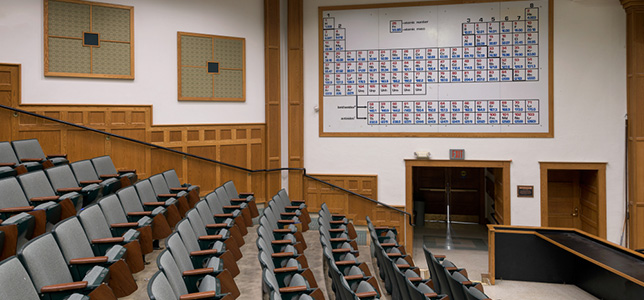
Photo: Nagel Photography / Shutterstock.com
More than half, 55 percent, of STEM classroom interactions are lectures, according to a new study from University of Nebraska-Lincoln researcher Marilyne Stains.
The study looked at 550 faculty as they taught more than 700 undergraduate STEM courses in more than 2,000 classes at 25 institutions in the United States and Canada.
About another quarter, 27 percent, of classes observed in the study featured interactive lectures that included group activities or the opportunity for students to respond to multiple choice questions with clickers. Only 18 percent featured extensive group work or discussions.
Yet research has repeatedly found that more interactive class formats result in more engaged students: "There is an enormous amount of work that has demonstrated that these (student-centered) strategies improve students' learning and attitudes toward science," said Stains, according to a report on phys.org. "It's not just that they understand it better, but they also appreciate science more. They're not as scared of it, and they engage more easily with it."
The researchers did find that lectures were less prevalent in smaller classrooms and in those with open designs, though about half of the classes observed in those spaces still featured lectures. Lack of teacher training may be the cause, according to Stains.
"When you talk to faculty, you often hear, 'I teach in an amphitheater. I could never do group work; it's just not practical. But if I had a small class, I could do it,'" Stains said, in a prepared statement. "But just because you have the right layout doesn't mean you're actually going to (promote) active learning. You need to be trained in those kinds of practices. If there's not a budget for professional development to help faculty use those environments, they're going to default to what they know best, which is lecturing."
Rather than depending on self-reports, as much research in the area has done in the past, Stain's team used a protocol that required documenting a range of student and instructor behaviors every two minutes.
"Surveys and self-reports are useful to get people's perceptions of what they are doing," Stains told phys.org. "If you ask me about how I teach, I might tell you, 'I spend 50 percent of my class having students talk to each other.' But when you actually come to my class and observe, you may find that it's more like 30 percent. Our perception is not always accurate."
The researchers also developed an app that teachers can use to track their own teaching methods.
"People can do their own measurements and see how they compare to this large dataset — see how either their department or college is doing — and say, 'This is where we stand. This is where we want to go,'" Stains added.
The full study is available at science.sciencemag.org.
About the Author
Joshua Bolkan is contributing editor for Campus Technology, THE Journal and STEAM Universe. He can be reached at [email protected].