'Nobel Prize for Education' Seeks 2019 Nominees
- By Dian Schaffhauser
- 12/13/18
The winner of last year's WISE Prize for Education, Patrick Awuah, left his home in Ghana to study at Swarthmore, giving him his first taste of education that was dramatically different from the rote learning he was used to from the schools he attended. Eventually, he joined Microsoft, where he worked as a program manager. But rather than continuing on that path, Awuah chose to head back to Ghana. And instead of pursuing his original intent — starting a software business — he established a school. Ashesi University began in 2002 in a rented house converted to classrooms that could hold up to 30 students. Presently, the 100-acre Ashesi University College is considered one of the country's premier institutions, educating more than a thousand "ethical, entrepreneurial leaders" from numerous countries in Africa and elsewhere.
Now the World Innovation Summit for Education is seeking nominations for its 2019 WISE Prize, akin to a Nobel Prize for education. The honor includes a $500,000 prize and can go to an individual or a team of up to six people.
The prize was established in 2011 by Her Highness Sheikha Moza bint Nasser, who has been engaged in education and other social reforms in Qatar for many years and has played a major role in spearheading national and international development projects.
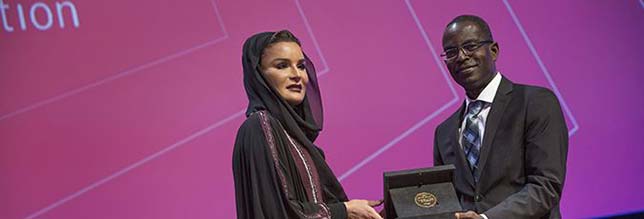
Her Highness Sheikha Moza bint Nasser presenting the WISE Prize for Education to Patrick Awuah at the eighth World Innovation for Education in Doha, Qatar in November 2017. Source: WISE Initiative.
Besides celebrating outstanding education leaders, the prize is intended to help support their work in shaping the future of education. Recipients also receive tailored support over two years to develop their initiative further and scale its impact.
During the course of the next year, a panel of judges will choose 12 WISE Prize finalists. They'll be asked to submit a proposal outlining how the prize could affect their programming and how increased funding could help them expand their efforts.
Judging criteria encompasses the nominees' commitment to education, the demonstration of systemic change through their leadership and the sustainability of their impact. One nominee will be selected as the Education Laureate, announced during the opening plenary of the 2019 WISE Summit, which takes place Oct. 28-30, 2019 in Doha Qatar.
Nominations for the 2019 WISE Prize for Education can be submitted through the WISE Initiative website.
About the Author
Dian Schaffhauser is a former senior contributing editor for 1105 Media's education publications THE Journal, Campus Technology and Spaces4Learning.