Education Helping to Drive Surge in AR & VR

Augmented and virtual reality will see massive growth in the next five years, driven in large part by both K–12 and post-secondary education.

According to a new forecast from market research firm IDC, AR and VR will grow at a compound annual growth rate (CAGR) of 78.3 percent for the next five years to reach nearly 10 times the scale it's expected to hit this year — from $16.8 billion in 2019 to $160 billion in 2023.

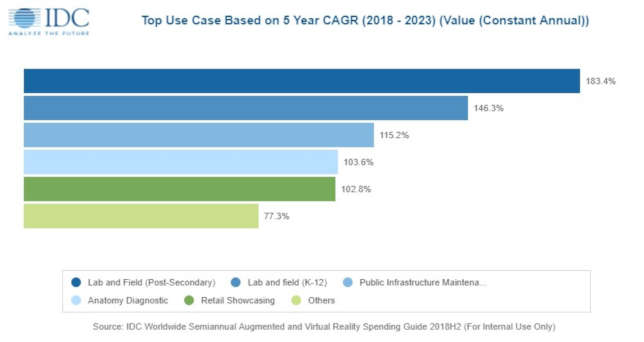
According to IDC, two of the top five use cases for growth are in the education sector:

  • Lab and field work in higher education, which is expected to grow at a CAGR of 183.4 percent over the forecast period; and

  • Lab and field work in K–12, which is expected to grow at a CAGR of 146.3 percent.
Education Helping to Drive Massive Surge in AR & VR 

The United States will not lead in either spending or growth. China will spend the most on AR and VR technology during the forecast period. The United States will come in second. The two combined will account for about three-quarters of the world’s spending on this technology category.

The fastest growth will be seen in Western Europe, followed by the United States and China.

According to IDC: “Hardware will account for more than half of all AR/VR spending throughout the forecast, followed by software and services. Strong spending growth (189.2 percent CAGR) for AR viewers will make this the largest hardware category by the end of the forecast, followed by VR host devices. AR software will be the second fastest growing category, enabling it to overtake VR software spending by 2022. Services spending will be driven by strong growth from AR consulting services, AR custom application development, and AR systems integration.”

For more information, go to IDC’s Worldwide Semiannual Augmented and Virtual Reality Spending Guide.

About the Author

David Nagel is the former editorial director of 1105 Media's Education Group and editor-in-chief of THE Journal, STEAM Universe, and Spaces4Learning. A 30-year publishing veteran, Nagel has led or contributed to dozens of technology, art, marketing, media, and business publications.

He can be reached at [email protected]. You can also connect with him on LinkedIn at https://www.linkedin.com/in/davidrnagel/ .


Featured

  • CIS Sandbox Tutor Eli Blouin at Bentley University imagines a future technology learning partner that supports curiosity, critical thinking, feedback, and personalized learning.

    Student Voices: Technology as a Future Learning Partner

    A data analytics and marketing major at Bentley University and a distinguished lecturer at the university explore the future of "technology learning partners" — technologies that participate in the learning process by asking questions and giving feedback, not just information search results.

  • Abstract energetic glowing lines with particles

    Meta Steps Up Enterprise AI Ambitions with Muse Spark Launch

    Meta has announced the launch of Muse Spark 1.1, a multimodal reasoning model designed for agentic AI, alongside a new Meta Model API that gives developers access to the model for the first time.

  • Businessman using laptop analyzing data and growth graph chart

    AI Budgets in Education Show No Sign of Decline

    The vast majority of education organizations (98%) expect their AI infrastructure budgets to either increase or hold steady over the next year, according to a recent report from cloud storage provider Wasabi.

  • Dana Brunson facilitates a roundtable discussion with research and higher education IT leaders

    Internet2: Closing the Access Gap for Research Cyberinfrastructure

    Internet2's Research Engagement Team brings CIOs and other campus technology leadership together with research computing and data facilitators, forming a community that enables research cyberinfrastructure at institutions of all types and sizes.