Johns Hopkins Dashboard Maps Global Coronavirus Cases
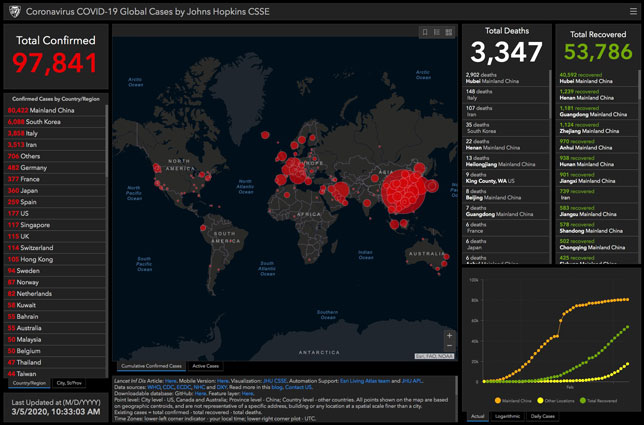
Coronavirus dashboard

Screen capture of the dashboard as of March 5, 2020

The Center for Systems Science and Engineering at Johns Hopkins University has developed an interactive, web-based dashboard that tracks the status of COVID-19 around the world. The resource provides a visualization of the "location and number of confirmed COVID-19 cases, deaths and recoveries for all affected countries," according to a university blog post.

The primary data source for the tool is DXY, a Chinese platform that "aggregates local media and government reports to provide COVID-19 cumulative case totals in near real-time at the province level in China and country level otherwise," the post explained. Additional data comes from Twitter feeds, online news services and direct communication sent through the dashboard. Johns Hopkins then confirms the case numbers with regional and local health departments.

All data from the dashboard is also freely available in a GitHub repository.

About the Author

Rhea Kelly is editor in chief for Campus Technology, THE Journal, and Spaces4Learning. She can be reached at [email protected].

Featured

  • abstract smartphone translucent screen displaying AI interface

    Apple Introduces Redesigned Siri AI

    At its recent Worldwide Developers Conference, Apple introduced Siri AI, a redesigned version of its voice assistant that Apple describes in its own announcement as "a profoundly more capable and personal assistant." The update is intended to make Siri more conversational, more context-aware, and more useful across iPhone, iPad, Mac, Apple Watch, and Vision Pro.

  • silhouette of business person facing wall of data

    Why AI Strategy Belongs in the President's Office

    Institutions that are succeeding with AI share one thing in common, and it is not a better committee, a larger budget, or a more sophisticated technology stack. It is a president who never handed off the steering wheel.

  • Blue digital wireframe classical building structure

    Before AI, Fix Your Data

    Institutions don't have to solve every data problem before they can begin using AI responsibly. But they do need to treat information as a strategic asset — not a byproduct of operations — and start building toward AI-ready data now.

  • Jason Palm

    AI, Identity, and Speed: Cybersecurity Priorities for Higher Ed

    Fortinet Security Operations Specialist Jason Palm explains how AI is raising new security challenges for higher education, requiring stronger governance, identity protection, threat detection, automation, and incident readiness.