U Florida Announces Plans for Fastest AI Supercomputer in Academia
- By Dian Schaffhauser
- 07/31/20
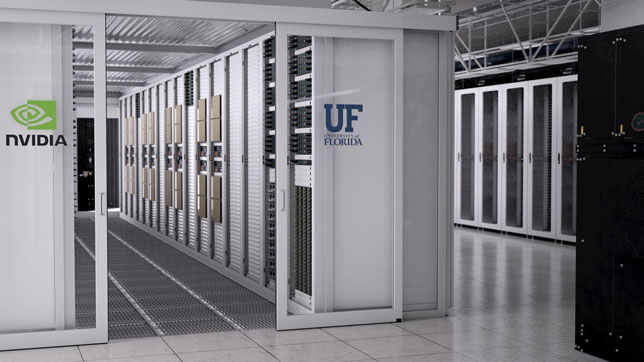
An artist's rendering of University of Florida's new AI supercomputer based on NVIDIA's DGX SuperPOD architecture. Source: NVIDIA
The University of Florida and NVIDIA have announced a $70 million artificial intelligence initiative that includes building what they're claiming to be the fastest AI supercomputer in academia. The university will invest $20 million to create an AI-centric supercomputing and data center. The project comes with a $50 million gift, half pledged by Chris Malachowsky, alumnus and NVIDIA co-founder, and half delivered as in-kind products and services from NVIDIA.
The effort will also include the infusion of AI into the school's curriculum, helping some 30,000 graduates learn how to embed AI into their work by 2030.
Rather than building from new, the university plans to boost the capabilities of an existing cluster, HiPerGator. The upgrade will use 140 NVIDIA DGX A100 systems running a total of 1,120 NVIDIA A100 Tensor Core GPUs. While the DGX A100 is designed for AI, it also can handle general high-performance research problems. The system will double existing storage to 4 petabytes and run an NVIDIA Mellanox HDR 200Gb/s InfiniBand network. It's expected to deliver 700 petaflops of compute, according to one report, equivalent to "thousands of servers."
The system is scheduled to be up and running by early 2021, a few weeks after it's delivered.
As part of the initiative the institution has committed to:
- Filling 100 new faculty positions in AI and related fields.
- Establishing an "equitable AI program," which will involve faculty members across the university creating standards and certifications for developing tools and solutions that are "cognizant of bias, unethical practice and legal and moral issues." That program will be led by Juan Gilbert, a professor in the department of Computer & Information Science & Engineering.
- Working with industry and academic organizations, such as the Inclusive Engineering Consortium, where students will work with members to conduct research and recruitment to UF graduate programs.
On the corporate side, the NVIDIA Deep Learning Institute will collaborate with UF to develop new course materials for students and the community, including programing revised to address the needs of young adults and teens and encourage their interest in STEM and AI. UF will also become the site of an NVIDIA AI Technology Center, where the university's graduate fellows will work alongside NVIDIA employees to advance AI. The company's own solution architects and product engineers will work with UF on the installation, operation and optimization of the NVIDIA-based supercomputing resources on campus, including AI software applications.
"This initiative will allow us to recruit and equip a diverse, talented cadre of faculty and students across multiple disciplines and bring them together with colleagues from government and the private sector to find solutions to our most important problems," said Cammy Abernathy, dean of UF's Herbert Wertheim College of Engineering, in a statement.
"The University of Florida's new supercomputing facility is an important addition to the AI ecosystem and will provide academic researchers with much needed access to computing power that can advance artificial intelligence far into the future," added Hodan Omaar, a policy analyst at the Center for Data Innovation, in a statement. "This partnership can and should serve as a model of how universities, industry and government can combine their respective strengths for the benefit of all."
About the Author
Dian Schaffhauser is a former senior contributing editor for 1105 Media's education publications THE Journal, Campus Technology and Spaces4Learning.