Survey: College Students Both Excited and Concerned about AI Tools

A May 2023 survey of Gen Z students conducted by Touchstone Research shows how students perceive generative artificial intelligence, how they use it, and what they’re using the tools for — and college students are more likely to be using the tools for school work than younger students.

For the “Generative AI Through the Eyes of Gen Z” study, Touchstone Research surveyed 931 students from middle school to college age, the firm said in a news release. The sample included equal numbers of male and female students and “representative proportions” of various ethnic groups, Touchstone said.

Fewer than two-thirds of respondents said they were “aware” of any generative AI tool.
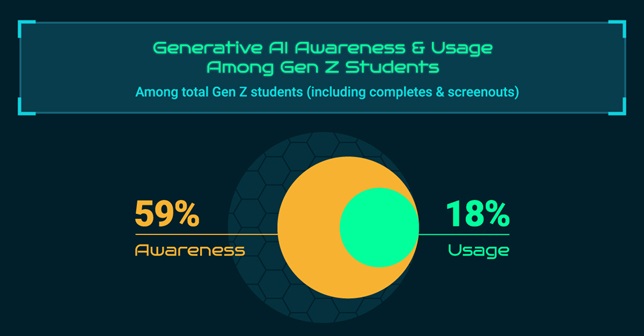
graphic shows percentage of students reporting they're aware of generative AI tools vs the percentage of students reporting they have used generative AI tools  

Just under a fifth of students surveyed, or 18%, indicated they have used any generative AI tool.

  • 16% have used ChatGPT

  • 4% have used Google Bard AI

  • 3% have used Bing AI

  • 2% have used DALL-E2

  • 1% have used Midjourney

Among students who indicated they have used generative AI tools, 75% said they’d used them to create art, images, videos and music.

  • 49% said they’d used the tools to “get information about something.”

  • 43% said they’d used generative AI tools to “help with schoolwork.”

    • College students: 51%

    • High-schoolers: 37%

    • Middle-schoolers: 35%

When asked, secondary students and post-secondary students reported similar feelings about generative AI, with only one difference:
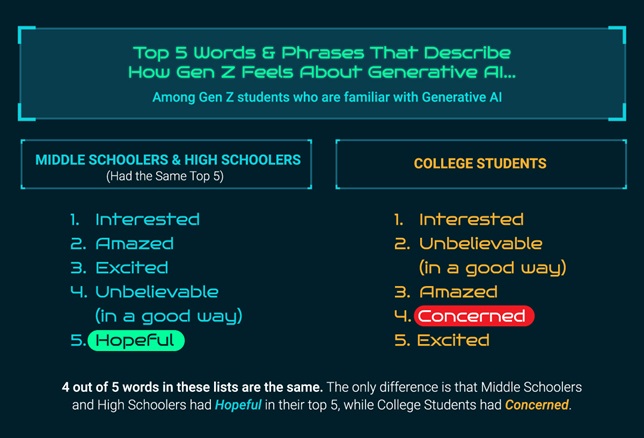
Graphic shows top five responses from college students vs. secondary students when asked how they feel about generative AI tools 

Students at every level generally felt the same about the potential impacts — and abuses — of generative AI:

  • 86% agreed that “generative AI is a big deal”

  • 77% agreed that “generative AI will have a big impact on their life”

  • 50% agreed that “government should regulate or limit generative AI”

Gen Z students who indicated they are familiar with generative AI were asked how it could benefit humanity. The top five answers were:

  1. Help people with disabilities by making it easier for them to do things on their own

  2. Improve healthcare by helping doctors find diseases faster and more accurately

  3. Make more knowledge available to more people

  4. Accelerate scientific discoveries, like finding cures for diseases or exploring outer space

  5. Help us talk to people from different countries by instantly translating languages

Learn more and view the full survey results at the Touchstone Research website.

About the Author

Kristal Kuykendall is editor, 1105 Media Education Group. She can be reached at [email protected].


Featured

  • closeup of hands using smart phone

    Learning Continuity Built into the LMS Withstands Cloud or Cybersecurity Interruptions

    When your institution's administrative or instructional capabilities face disruption from natural, technical, or malicious events, what measures does your LMS offer to provide a "business as usual" operating and learning environment? Instructure's Ryan Lufkin comments on the LMS and learning continuity.

  • digital brain with network connections

    Microsoft Moving to Internally Developed AI Models in Office Apps

    Microsoft is reportedly using its own in-house artificial intelligence models to handle some workloads in Excel and Outlook, offering new evidence that the company is moving its AI strategy beyond model development and into large-scale cost reduction.

  • businessman holding tablet with holographic AI icons

    Google Moves AI Agents into the Mainstream

    At its recent I/O developer conference, Google presented artificial intelligence agents not as a distant research project, but as a product strategy spanning Search, personal assistants, productivity software, developer tools, and smart glasses.

  • artificial intelligence on laptop

    OpenAI to Combine AI Products into Desktop 'Superapp'

    OpenAI is reportedly developing a desktop application that would combine several of its emerging AI products into a single platform, according to reports, marking the latest step in the company's effort to transform ChatGPT from a standalone chatbot into a broader productivity and automation environment.