Help Desk 411
Whether institutions outsource or run their own help desks, most
question how they can make sure the services they provide are
effective. "You need to take time to step back and look at who
really is using your services and how," says Bill Bradfield, CEO of
PerceptIS, a provider of customer support services
to higher education. The following findings from PerceptIS'
study of its own client data may provide some valuable insights.
Most help desk
inquiries come
from faculty
and staff.
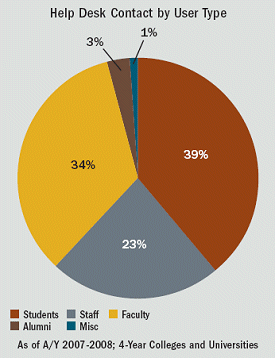 It's a common
assumption that
help desk services
are created for and
used by students.
But PerceptIS found
that nearly 60 percent
of four-year college
and university
help desk contacts--
including telephone,
e-mail, chat, and
other communications
with help desk
personnel-- are in
fact initiated by faculty and staff. At community colleges, the
percentage of student use of the help desk increases; with
less residential housing, there is less immediate peer support
at community colleges-- and so more use of the help desk by
students. But in general, help desk volume is not overwhelmingly
dominated by students.
It's a common
assumption that
help desk services
are created for and
used by students.
But PerceptIS found
that nearly 60 percent
of four-year college
and university
help desk contacts--
including telephone,
e-mail, chat, and
other communications
with help desk
personnel-- are in
fact initiated by faculty and staff. At community colleges, the
percentage of student use of the help desk increases; with
less residential housing, there is less immediate peer support
at community colleges-- and so more use of the help desk by
students. But in general, help desk volume is not overwhelmingly
dominated by students.
Faculty and staff prefer
telephone calls; students favor
electronic messaging.
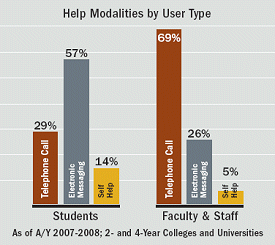 Of the help desk and self-help options open
to them, users go for a comfortable fit. PerceptIS
noticed that students opt for electronic
messaging (e-mail, chat, etc.) by far,
over telephone contact with the help desk.
Faculty and staff, on the other hand, will
most often call for assistance. That means
it's a good idea to staff the phones with
people who can deal with high-end customers.
And what about new highly touted
self-help services (use of a knowledge bank
and/or other resources, as opposed to personal
contact)? PerceptIS noted that faculty
rarely if ever use self help, and students
use it only a little more than that-- data
that correlate interestingly with an industrywide
data point from the Help Desk Institute's
2007 Annual Survey: Only 3 percent of inquiries get
resolved at the self-help level!
Of the help desk and self-help options open
to them, users go for a comfortable fit. PerceptIS
noticed that students opt for electronic
messaging (e-mail, chat, etc.) by far,
over telephone contact with the help desk.
Faculty and staff, on the other hand, will
most often call for assistance. That means
it's a good idea to staff the phones with
people who can deal with high-end customers.
And what about new highly touted
self-help services (use of a knowledge bank
and/or other resources, as opposed to personal
contact)? PerceptIS noted that faculty
rarely if ever use self help, and students
use it only a little more than that-- data
that correlate interestingly with an industrywide
data point from the Help Desk Institute's
2007 Annual Survey: Only 3 percent of inquiries get
resolved at the self-help level!
Help is where you find it.
Whether it's a faculty member feeling more connected via telephone, or a student who would rather fire off
an instant message, you will most likely want to prepare for a wide range of "help" options. Bradfield comments:
"A one-size-fits-all approach to service is an inadequate value proposition. People want to get help in
the manner that is best suited to them. That could mean a phone call, a chat session, a web form, an e-mail,
self help, self service, or the emerging phenomenon of crowdsourcing-- whatever means is most convenient
and most comfortable for end users. More and more, you will need a quiver full of arrows when it comes to
support services."
Source: PerceptIS LLC