InFocus Debuts Large Venue Projectors
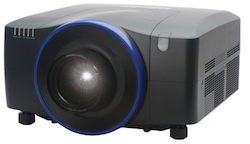
The IN5542 and IN5544 from InFocus feature support for seven lenses and motorized lens shift, zoom, and focus. |
InFocus has recently rolled out a series of high brightness LCD installation projectors for use in auditoriums, lecture halls, and other large venues.
The new series consists of the IN5542, an XGA (1,024 x 768) model with a brightness of 7,500 lumens, and the IN5544, a WXGA (1,366 x 800) model with a brightness of 6,500 lumens. Both units have a contrast ratio of 2,500:1 and accommodate up to seven lenses with varying throw ratios and zoom capabilities, though neither unit ships with a lens.
Both models support RS-232 control, daisy chains through RS-232 connections, and wired Ethernet. Other features common to both models include motorized lens shift, zoom, and focus, a lamp life of 2,000 hours, economy mode, a filter life of 10,000 hours, and direct power on/off.
Features of the IN5542 include:
- An image width ranging between 32 inches and 560 inches;
- Automatic vertical keystone correction of ±40 degrees; and
- Automatic horizontal keystone correction of ±20 degrees.
Features of the IN5544 include:
- Image width ranging between 34.5 inches and 603 inches;
- Automatic vertical keystone correction of ±15 degrees; and
- Automatic horizontal keystone correction of ±5 degrees.
Available lenses include:
- Ultra short throw with a throw ratio of 0.5 to 0.6 and a 1.2x zoom;
- Short throw with a throw ratio of 1.2 to 1.5 and a 1.2x zoom;
- Standard with a throw ratio of 1.8 to 2.3 and a 1.3x zoom;
- Standard short with a throw ratio of 1.5 to 2.2 and a 1.5x zoom;
- Standard long with a throw ratio of 2.2 to 2.9 and a 1.3x zoom;
- Ultra long throw with a throw ratio of 5.0 to 9.2 and a 1.8x zoom; and
- Long throw with a throw ratio of 2.8 to 5.2 and a 1.8x zoom.
The IN5542 has a horizontal lens shift of ±58 percent and a vertical lens shift of +37 percent -137 percent when equipped with any of the seven lenses other than the standard lens and the ultra short throw lens. When a standard lens is equipped the IN5542 has a horizontal lens shift of ±32 percent and a vertical lens shift of +0 percent -100 percent. The ultra short throw lens maintains a fixed position.
Horizontal lens shift for the IN5544 is ±61 percent and vertical lens shift is +77 percent -177 percent except when equipped with a standard lens or ultra short throw lens. The standard lens allows a horizontal lens shift of ±35 percent and a vertical lens shift of +27 percent -127 percent.
The projectors measure 10.7" (h) x 18.7" (w) x 18.5" (d) and weigh 41 pounds.
AV inputs include HDMI, DVI-D, 5BNC, component, S-video, and Composite. AV outputs include analog RGB/component (mini D-sub 15-pin). Communication ports include RJ-45 LAN, RS-232 in, and RS-232 out.
The IN5542 can be had for $9,499 while the IN5544 can be found for $9,999.
Further information on the IN5542 and the IN5544 is available at infocus.com.
About the Author
Dan Thompson is a freelance writer based in Brea, CA. He can be reached here.